Tag Archives: Marriage Counseling

What Is Attachment & Somatic Couples Therapy?


When Marie and Eric showed up in my office, they seemed happy enough together. At least, they had built the life they told themselves they wanted. But beneath the surface, their bodies told a different story, which is exactly why they were seeking somatic couples therapy.

Eric smiled as Marie talked, but it was the kind of smile that appeared to take considerable effort. Marie smiled too, yet she rarely looked at her husband as she spoke. Instead, she stared toward the floor, her eyes hovering on the edge of tears.

Over the years, I have noticed that many couples arrive in marriage counseling already knowing a great deal about themselves. Perhaps you’ve read the books. Maybe you’ve listened to the podcasts, taken the quizzes, or spent years in individual therapy. You may understand your childhood wounds, know your attachment style.

And yet, something still happens when conflict begins.

Schedule a Free Couples Consultation

Maybe it’s the same argument you’ve had dozens of times before. The details change, but the hurt feels the same. Then comes the distance, the tension, and the private longing to feel close again.

So it can be confusing when all that insight doesn’t seem to create lasting change. After all, if understanding the problem were enough, shouldn’t things be getting better between you?

Not necessarily. In fact, one of the most common things I hear from couples is some version of: “We know what’s happening between us. We just can’t seem to stop it.”That statement sits at the heart of why I practice both attachment-based and somatic couples therapy.

Attachment therapy helps you understand the emotional meaning underneath recurring conflict. Somatic therapy helps you understand what happens in your body and nervous system when those conflicts arise. Together, couples move beyond simply talking about your problems and begin creating new experiences of safety, connection, and repair.

In my experience, lasting change happens when partners learn to recognize the relationship dance they are caught in, understand what’s happening beneath it, and respond differently when old patterns emerge.

Most Relationship Problems Are Not Communication Problems

At first, this idea surprises many couples.

After all, communication is usually the reason people seek therapy in the first place.

Perhaps you’ve said things like:

  • “We need better communication tools.”
  • “If she would just say what she means.”
  • “If he would actually listen.”
  • “We need to stop fighting about the same things.”

Communication certainly matters. Yet in my experience, communication difficulties are often symptoms of the problem rather than the problem itself.

Beneath disagreements about parenting, intimacy, money, or household responsibilities, there is often a more vulnerable question waiting to be answered.

As human beings, we are wired for connection. We need relationships where we feel valued, protected, and emotionally significant. Yet needing another person can also feel deeply vulnerable.

That’s why many conflicts are really asking questions such as:

  • Am I important to you?
  • Can I count on you?
  • Do you have my back?
  • Are we on the same team?

These are attachment questions.

Often, we ask them without realizing it. We look for answers in our partner’s tone of voice, facial expressions, availability, and responsiveness. When our need for connection feels threatened, even loving partners can begin to look like adversaries.

Not because love has disappeared.

Not because the relationship is broken.

But because fear has entered the conversation.

The Dance Beneath the Conflict
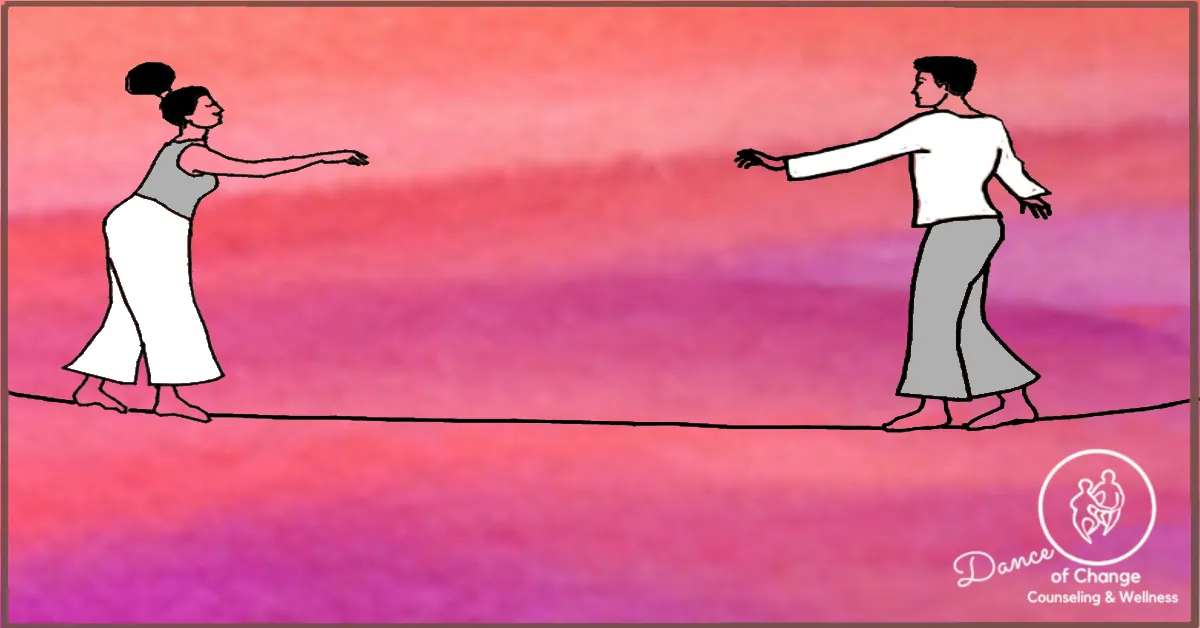
Couple on a tightrope representing how couples feel when they start Marriage Therapy in St. Louis, MO

Most couples arrive focused on the latest argument.

Perhaps it was the fight from Tuesday. Maybe it was a comment that stung, a misunderstanding that spiraled, or a conversation that somehow became five different conversations.

The disagreement itself feels like the problem.

I tend to look for something else.

I look for the dance.

Over time, every couple develops predictable patterns. One partner reaches for connection while the other seeks space. Criticism is met with defensiveness. Intensity is met with withdrawal. The louder one person becomes, the quieter the other grows.

Meanwhile, both partners are trying to solve the same problem.

Neither feels understood.

The details may change, but the dance often remains remarkably consistent.

One of the most important shifts in couples therapy occurs when partners stop seeing each other as the problem and begin recognizing the pattern itself.

The argument about dishes is rarely about dishes. The argument about sex is rarely just about sex.

Schedule a Free Couples Consultation

Beneath most recurring conflicts is a struggle around safety, trust, significance, connection, autonomy, or protection.

This was certainly true for Marie and Eric.

Both agreed that parenting their two young children had become the greatest source of stress in their relationship. Marie felt the burden of parenting rested unfairly on her shoulders. Eric believed she failed to see how hard he was trying to show up while managing significant job pressures.

Each had a convincing story.

Each felt misunderstood.

As we slowed the conversation down, something important emerged. Parenting was part of the story, but it was not the whole story.

Beneath Marie’s frustration was a longing to feel supported and understood.

Beneath Eric’s defensiveness was a fear that no matter how hard he tried, he would still disappoint her.

The conflict wasn’t simply about parenting.

It was about connection.

Underneath Your Story Lies Another Truth

Many couples understand their dance surprisingly well.

Some can explain their patterns beautifully.

Marie might say, “I know I become anxious when he’s away.”

Eric might respond, “And I know I shut down when I feel pressured.”

This is often the gift of individual therapy. You have spent time learning your history, understanding your triggers, and making sense of your emotional reactions.

And yet, the same cycle continues.

Why?

Because relationships are not simply a thinking experience. They are a brain-body experience.

During moments of stress, insight alone often cannot compete with fear, habit, and nervous system reactions that have been rehearsed for years.

That is why some of your smartest relationship solutions may have fallen flat.

“We just need to stay calm.”

“I need you to communicate more.”

“Let’s not fight about this.”

All of those ideas sound reasonable. Yet when emotions rise, many couples discover they cannot access the skills they know they have.

Knowledge matters.

Insight matters.

But change requires more than understanding.

Both partners need new experiences that teach the nervous system something different.

The Nervous System Joins the Dance
Dancing_Feet_of_a_Couple_to_show_Nervouse_System_Regulation

This is where somatic couples therapy becomes especially important.

Many couples already know what they are supposed to do differently. Yet when conflict arrives, something else takes over.

Your heart races.

A  tightness in your chest constricts your breathing

Your muscled ready for action.

Attention narrows. Thoughts also narrow.

An urge to defend, explain, criticize, fix, pursue, withdraw, or shut down appears almost automatically.

Long before words are exchanged, your nervous system is already gathering information and asking a simple question:

Am I safe right now?

Most of this process occurs outside conscious awareness.

When the nervous system detects danger, it shifts into protection. For some people, that means becoming reactive, demanding, or critical. Others become anxious and desperate to reconnect. Still others go quiet, numb, or emotionally disappear.

These are not signs of weakness.

They are adaptive survival responses.

Unfortunately, what protects us individually can create distance in relationships.

As one partner pursues, the other often feels overwhelmed.

That overwhelmed partner withdraws, and the other often feels abandoned. Their impulse is to pursue more.

Gradually, the dance becomes more rigid.

And the relationship becomes more painful. And resentment can set in

Marie and Eric illustrated this perfectly.

When Marie felt hurt, her voice changed. Her body tightened. Without intending to, she communicated distress through her tone, posture, and expression.

Eric immediately interpreted those signals as criticism.

His jaw tightened.

He felt as though he could barely breathe. 

Part of him wanted to defend himself. Another part wanted to escape entirely.Neither intended to hurt the other.

Marie criticized because she felt alone.Eric withdrew because he felt defeated.

The more alone Marie felt, the more she protested. The more defeated Eric felt, the more he pulled away.

Both were trying to protect themselves.Neither was getting what they truly needed.

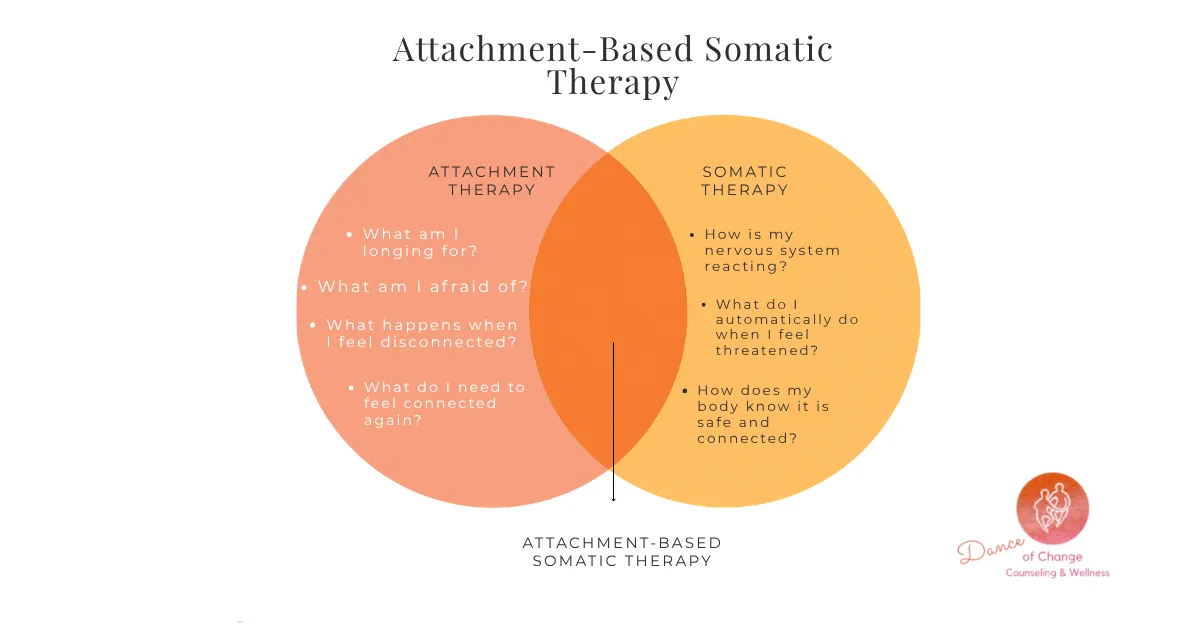
What Attachment and Somatic Therapy Look Like Together
A venn diagram showing the different elements of Attachment-based Somatic therapy

At its core, attachment therapy helps you understand the emotional meaning of your interactions.

Somatic therapy helps you understand the bodily experience of those same interactions.

Together, they create a powerful framework for change.

Attachment work asks:

  • What am I longing for?
  • What am I afraid of?
  • What happens when I feel disconnected?
  • What do I need to feel connected again?

Somatic work asks:

  • What happens in my body when I feel either triggered or connected?
  • How does my nervous system react? What are my non-verbal signals?
  • What do I automatically do when I feel threatened? Or when I feel safe? 
  • What are my partner’s non-verbal signals telling me?

For many couples, years have been spent talking about problems.

Far fewer have learned to notice what is happening inside them while those problems unfold.

Maybe your partner’s voice gets louder.

A knot forms in your stomach.

Breathing becomes shallow.

Meanwhile, your mind begins creating stories about what is happening and what it means.

Within seconds, conflict can shift from connection into protection.

By recognizing these moments earlier, new choices become possible.

Curiosity begins replacing certainty.

Understanding becomes more accurate.

Difficult conversations become easier to navigate without losing connection.

What Secure Relationships Actually Look Like

Many people imagine secure relationships as relationships without conflict.

That has not been my experience.

Even secure couples disappoint each other. Misunderstandings happen. Hard conversations happen. Hurt happens.

The difference is not the absence of problems.

It actually lies in what happens next. After the problems. 

Secure couples learn how to repair.

Rather than staying stuck in old patterns, they learn how to turn toward one another again.

Over time, they become more skilled at recognizing when the dance has taken over.

Even during disagreement, they work to protect the relationship rather than defeat each other.

Connection becomes something they practice intentionally.

Gradually, each partner becomes a source of safety for the other.

In many ways, secure relationships are not built through perfection.

They are built through countless moments of repair, responsiveness, and reconnection.

A Different Path Forward

Many couples begin therapy believing they need better communication skills.

Sometimes they do.

More often, they need help understanding the pattern they have become trapped in.

That means recognizing the attachment fears driving the conflict. It means noticing the nervous system responses that keep pulling both partners back into old reactions. And it means learning how to respond to one another in ways that create greater trust and safety.

Words matter.

Nonverbal communication matters too.

A facial expression, a shift in posture, a sigh, a tone of voice, or a moment of eye contact can communicate threat or reassurance long before words are exchanged.

Most couples need help understanding what their partner is actually expressing rather than what they assume it means.

They also need opportunities to experience each other differently.

Because lasting change rarely comes from insight alone.

Instead, it emerges through repeated experiences of vulnerability, responsiveness, safety, and repair.

The goal of attachment and somatic couples therapy is not to eliminate conflict.

The goal is to help you stop fighting each other and begin understanding the dance you are both caught in.

Once that happens, your relationship can begin moving in a different direction.

And often, that is where real change begins.

Ready to Stop Having the Same Fight?

If you and your partner feel trapped in the same painful cycle, Attachment & Somatic Couples Therapy can help you understand what’s happening beneath the conflict and create lasting change together. Our Licensed Marriage and Family Therapist and Somatic Therapists are available to help. We are located in Saint Louis, Missouri and offer both in person and tele health options.

Schedule a Free Couples Consultation

Frequently Asked Questions 

What is Attachment & Somatic Couples Therapy?

Attachment & Somatic Couples Therapy combines attachment theory with body-based approaches to help couples understand and change recurring relationship patterns. Instead of focusing only on communication skills, this approach explores how past experiences, nervous system responses, emotions, and nonverbal cues influence the way partners connect, protect themselves, and respond to conflict.

How is this different from traditional couples counseling?

Traditional couples counseling often focuses on improving communication and problem-solving skills. Attachment & Somatic Couples Therapy goes deeper by helping couples understand the underlying emotional and physiological patterns driving conflict. Partners learn to recognize how their nervous systems react during moments of stress and develop new ways to create safety, trust, and connection.

Can this form of Couples Therapy help if we have the same arguments repeatedly?

Yes. Repetitive conflict is often a sign of an attachment cycle rather than a communication problem. This approach helps couples identify the deeper fears, needs, and protective behaviors beneath recurring arguments. By understanding the cycle together, couples can respond differently and create more productive conversations.

How do I know if  Couples Therapy is working?

Progress in Somatic Couples Therapy is often measured by changes in your relationship patterns and nervouse sytstem level of activation and recovery. Not the complete absence of problems. You may notice that arguments become less intense, repair happens more quickly, and both partners feel more understood and emotionally safe together. Common too, is the ability to return to a calm and connected state. Many couples report becoming more aware of their triggers, responding less reactively, and feeling more connected even closer during and after difficult conversations.

Over time, the goal is not to eliminate differences but to create a more secure, resilient relationship where both partners can navigate challenges while strengthening their bond.

After the Fight: One Couple’s Story and 3 Key Lessons (Part 1)

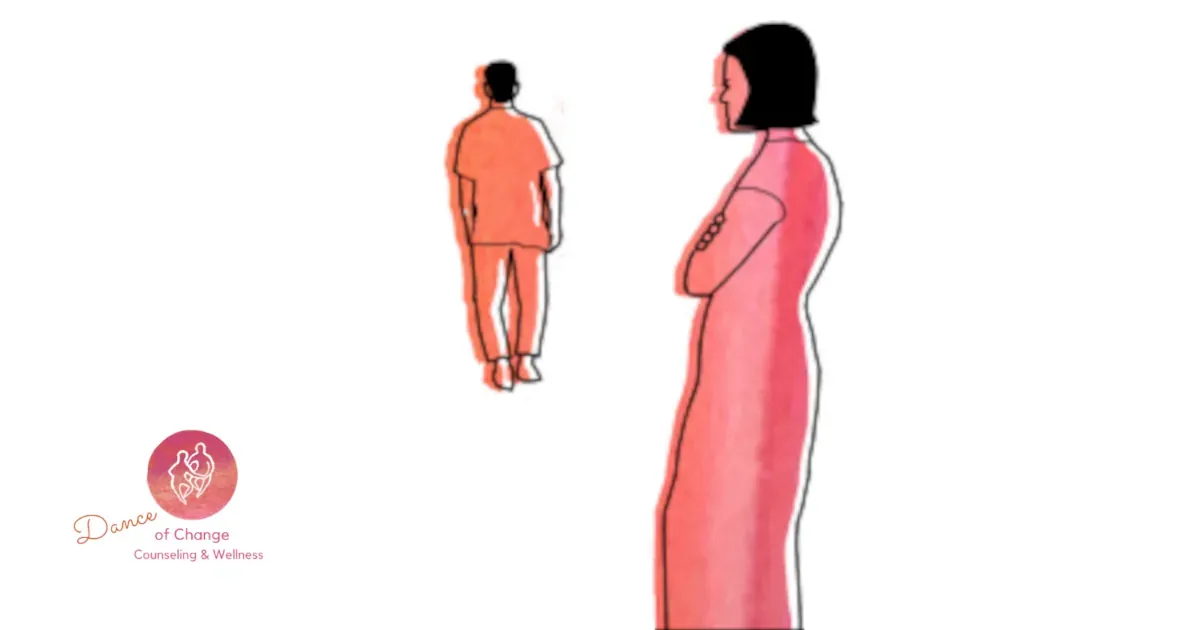
A distant couple in therapy

“If that’s what you think, than I’m done with this marriage!” Joan shot one hand into the air as though giving a warning shot. She took a step towards the door and then paused. As soon as the words escaped her mouth she instantly regretted them.But she couldn’t take them back. The words flew out before she had actually registered completely. There was a part of her that hoped that Jerome would not take the words seriously. That he would continued to fight for the marriage as he had at the beginning of their relationship. But that’s not what happened.

“Fine. I can’t believe I wasted 25 years of my life” His words were sharp but his tone steady. As though he had been secretly waiting for this movement.

Two weeks went by before they showed up in my office. By then their tone with each other had changed. They were soft spoken and full of remorse. But the air around them was thick with tension.

The Two kinds of Couples Fights

All couples fight. I’m not talking about chronic physical fights that are part of domestic violence. Rather, the verbal and emotional fights that are part of life together as a couple. That can range anywhere from quiet disagreements and misunderstandings to escalating arguments that lead to yelling matches and even threats. Fighting is a normal part of any intimate, long-term relationship. But there is a difference between fights that lead to lasting damage in a marriage vs ones that ultimately make you both stronger.

In a way, you could say there are just these two kinds of fights. You could thing of them as forks in the road of a train track. If your marriage is a train, it can either take the Lasting Damage Track or the Strong Repair Track. One leads to a weakness and the ultimate demise of the marriage, and the other has the potential to make the marriage stronger.

The Damage Track & Gridlock

It was clear that Joan and Jerome were on the lasting damage track of their marriage. Jerome sat back in his chair, his arms crossed—a clear shield. While Joan sat lightly at the edge of her seat, as though suspended from a hanger. Her hands circled nervously around each other. She appeared ready to bolt at any moment.

Despite the obvious tension between they both appeared helpless as to what to do about it. Neither was able to make eye contact, except with me as their couple’s therapist. Their faces appeared weighed down by the enormity of what they knew they were here to unpack. No one wanted to make the first move.

This is marital gridlock. And it’s one of the features of the damage track. I suspected Jerome and Joan had been on this track for awhile.

Couple Fighting
Fights with your partner don’t have to get this bad

The Context of a Big, Ugly Fight

Fighting doesn’t occur in a vacuum. There is always a context. After some initial unpacking, the context of the damage to their marriage became clear. Jerome had been in a bad mood for months due to the stresses and increased demands of a new job. When under stress he tends to withdrawal. He spent long hours at the office trying to get up to speed. This was followed by increased time at the gym to try to combat the stresses.

Stress & Denial

“I told myself it was all just temporary” he said. Then six months went by. Then, nine months. Before he knew it anxiety, stress and overwhelm had taken over his life. He was never home and felt guilty. But when he was home, he also felt he was letting people at work down. Depression started to set in.

Joan, on the other hand, felt more stable, at least at first . Initially, she was understanding and accommodating to Jerome’s absence. She stepped up more at home without complaint. She took on the mother-load of parenting their two kids. But after a while resentment started to build. “How long exactly was this going to go on?” She thought. Also, she felt unappreciated by Jerome. Underneath she was lonely.

Buried Feelings & Criticism

She missed Jerome and was tired of feeling like a single parent. But she didn’t say any of this to him for fear of stressing him out more. Under stress Joan alternates between withdrawal and criticism. The criticisms of Jerome were subtle at first, and slowly built to a crescendo. Eventually, she couldn’t hold back any longer. There was so much stored resentment over the months and years that it all came flooding out. Suddenly, the “D” word was on the table. Divorce was not what either of them wanted. Yet, somehow it had come to this.

Depressed person with their head down

Poor Communication

Looking back, neither of them had talked about the new job and it’s potential impact on their marriage and on their lives. No one discussed feelings and expectations about the multiple roles they shared together. And nothing was negotiated in advance. In fact, it was apparent they didn’t talk much at all. Except about the most trivial things: their favorite show, whose turn it was to take out the trash or pick up the kids.

Had they sat down and communicated these things with each other it might have been different. If they had communicated openly, while staying present and emotionally vulnerable, they might have prevented a fight in the first place. Or at least the damaging kind.

Lesson 1: Open Communication + Vulnerability = Damage Prevention

Both Joan and Jerome felt injured by the things said just two weeks before. And both had regrets. Yet, they had not been ready to admit them, until now. Once the air had cleared between them a bit, it was time. Joan elected to go first. We went over the elements of a good repair. If took some practice but she eventually got it.

“I know I said some things that were hurtful to you … things I wish I could take back now”. her hands continued to turn over and over again in her lap as she spoke. Jerome kept his eyes on particular spot on the rug. He nodded gently in acknowledgement.

Couple making a repair after a fight

Lesson 2: For a stronger bond, learn the art of repair

One of the reasons so many of their fights had continued to escalate and gone off the rails, is that they had never repaired the previous one. Many couples are unsuccessful at resolving conflict because they don’t know the elements of a good repair or how to put them into practice. without that knowledge, the cycle inevitably continues.

Lesson 3: The need to be right can kill a marriage

Part of the problem is that both Jerome and Joan wanted to be right. They wanted to defend their position and convince the other that they were in the wrong. This usually falls flat of course, and just leads to more fighting. Terry Real, a well-known couples therapist, is often credited with saying, “You can be right or you can be married, what’s more important to you?”

If the relationship is most important than one person needs to decide to let go of the need to be right. This is often easier said than done. But once couples figure it out, it becomes a key element in making a good repair and upending the fight cycle.

Want more Tips on How to Fight Right? Hoping to end the Same old endless Argument ?

Sign up to get Our Free Master Class series : How to Fight Right. And get parts 1,2,and 3 direct to your inbox.

Plus, we’ll send you Part 2 of the story of Jerome & Joan and lessons they learned after 16weeks of therapy

Couple Hugging

Ready to Schedule a Couple’s Therapy or Marriage Therapy appointment?

Contact our office to get connected to an experienced Licensed Marriage and Family Therapists who can help transform your fights into deeper connection.

We are located in St Louis, Missouri and serve couples in the surrounding areas. This includes : Richmond Heights, Clayton, Webster Groves, Kirkwood, Crestwood, Maplewood, Brentwood, Rockhill, Maplewood, Shrewsbury, Lindenwood, Ladue, Central West End and the surrounding city areas.

Give us a call at: (314) 827-5448 or email us at admin@danceofchange.com

We offer in person sessions in our office in Saint Louis, MO in Richmond Heights as well as video (Telehealth) session for anyone located in the state of Missouri

The Sexless Marriage: One Couple’s Story

Sexless Marriage

Jada and Pat had come to me because of a sexless marriage. Jada sat on one end of the couch, her arms folded tightly across her chest, her eyes fixed on a distant point on the wall. Pat sat on the other end, his shoulders slumped, his gaze cast downward. The counseling room was dimly lit, creating a sense of intimacy that contrasted with the obvious distance between them.

Pat and Jada ( not their real names)  were an attractive couple in their 50’s who had been married for more than 20 years and have two grown kids. From the outside they had all the obvious trappings of success. They had developed careers that were both personally and financially rewarding. Together they had bought and renovated a beautiful home, and successfully raised two healthy and thriving kids. Yet, beneath the veneer of success lurked another story.

Shadows of Discontent

Jada, with her poised demeanor and impeccable style, appeared to commanded respect even in the therapy room. As a respected figure in the business community, she had gained admiration from colleagues from a combination of grace and confidence. Her vibrant smile and friendly demeanor masked the inner turmoil she faced, behind closed doors.

Pat, too, appeared outwardly successful in his endeavors. With his easy charm and affable personality, he navigated social gatherings with ease, effortlessly engaging in conversations with friends and acquaintances. As a dedicated father and provider, he took pride in his role within the family, his unwavering commitment to their well-being evident in his every action. Yet, beneath his jovial exterior lay a sense of frustration and longing, just beneath the surface.

Despite their outward appearance of success, the cracks in their marriage remained, hidden from view but clear once they were both behind closed doors. After getting to know them a little bit, the conversation eventually turned to the reason for their visit: a sexless marriage.

Resignation and Resentment

Jada’s lips tightened when I brought up the topic. She shifted uncomfortably in her seat before speaking. Her voice was barely above a whisper. “It’s difficult for me to talk about that part of my life… I just don’t feel like myself anymore…” Her voice trailed off for a moment and then returned. “it’s like something inside me shut down. I have no desire” “ I know it would make Pat happy, but I can’t manufacture something that’s not that. The fact that he wants it so badly only makes me feel worse.” “I know he’s not trying to pressure me, but I do feel pressured”

Pat’s brows furrowed, his frustration evident. “She thinks it’s just about the physical aspect; but it’s not. I miss that connection we used to have. it’s about feeling close to Jada. And when she shuts me down like this, it hurts.” Pat sighed heavily, his voice tinged with resignation. “I feel like I’m not enough for her, like I’m failing as a husband. And after so many rejections, I just stopped trying.”Jada’s eyes brimmed with tears, and she shook her head.

The Couples Dance: The 5 communication patterns the Keep you and your partner stuck

The Many Reasons Sex Can Disappear from marriage

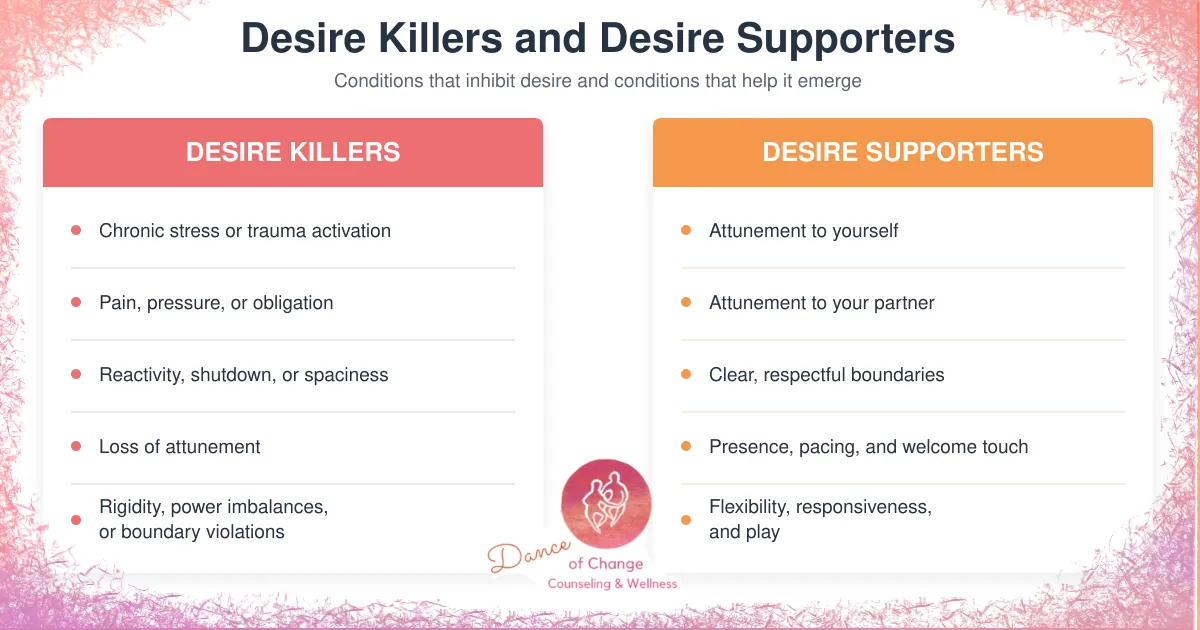
Let’s talk about sex pain for a minute. Painful sex, if left unresolved can lead to emotional, physical, and relational damage if left untreated.

sexless marriage

Dealing with Physical Barriers to Sex

Let’s talk about sex pain for a minute. Painful sex, if left unresolved can lead to emotional, physical, and relational damage over time. It then becomes a complex bundle of issues. Both Jada and pat had some physical challenges to deal with. For Jada, she needed to confront the physical, mental and emotional changes that went along with menopause, starting with decreased desire. Pat had some physical issues of his own. A life-saving medical procedure of his prostate, had left him with slight nerve damage. In his recovery, he worried about his sexual performance. Even if Jada’s desire did return, would he still be able to pleasure her?

After a combination of couples therapy, as well as consultations with medical professionals, both Jada and Pat were able to work through these physical issues. Until finally, the emotional and relational issues were all that remained.

Working through Relational Road Blocks that lead to a Sexless Marriage

“I didn’t know how to put it into words.” Jada said cautiously, but there is a part of me that still is hesitant to open up to Pat. It’s like I’m afraid to be vulnerable.” “ Things have definitely gotten better between us, but it’s still hard to trust it” Pat reached out tentatively, his hand finding hers on the couch. He spoke with a growing certainty in his voice. “Jada, I love you, and I’m here for you, no matter what. We’re in this together.” Jada’s lips quivered, but also she looked relieved. She squeezed his hand lightly. “I love you too, Pat.” She appeared as though stepping cautiously onto ice. “ I want us to find our way back to each other.”

The biggest Myth of the Sexless Marriage

One of the biggest myths of marriage is that loss of a sex life is inevitable. This is just not true. Many couples have a rewarding sex life, even later in life. You don’t have to accept sexlessness as a normal stage of life. This is even true of couples in midlife who have been together for decades, and have weathered a lot of stressors together. Change is always possible, especially if both partner’s want the transformation. Good sex is not just a thing belong to youth, or only possible at the early stages of a relationship. Actually, it is possible to rekindle desire in marriage at any stage of life. And it is also possible to have the best sex of your life at midlife or even later.

Gently Expanding Capacity for Pleasure

Over time, Jada and Pat’s relationship began to take a different shape. After working though relational road blocks they had learned to become safely embodied again. Instead of their usual habit of retreating into their individual spheres for safety, Jada and Pat made a conscious effort to prioritize their relationship. They carved out time for romantic dates and intimacy. Their growing communication and intimacy skills allowed them to continue to both expand and deepen their connection. Plus, they knew how to monitor each other’s stress levels and shift gears when needed. They took fun, safe, risks together while maintaining their enjoyment of each other. When hard stuff arose, they were able to work through it quickly, directly and skillfully. In short, they were building both the skills and capacity for pleasure and long-lasting intimacy.

Marriage Counseling

What’s Possible for Sex in Marriage

After weeks an months of practice, Pat and Jada showed up in my office markedly different. Gone were the complaints of a sexless marriage. Instead, there was a lightness in the air, and casualness about them that made them appear younger than their years. Their interactions seemed genuine and even flirtatious. In my office, they both appeared to glow a little. Gone were the tense silences or angry outbursts. Instead, their was a depth to their conversation, followed by moments of playful banter. They appeared almost to as different people. But of course they weren’t.

After recounting a fabulous dinner together, followed by steamy sex Jada laid back in her chair, then straightened a bit.

“ I don’t know if I want to stay married” she declared to Pat, a clear hint of flirtation in her voice. “ Can we just keep on dating each other?”. A moment of fear flashed across Pat’s face, and then relaxation. He reached out caressed her arm gently.

“How about we stay married AND continue to date each other?” Jada thought about this then laughed playfully.

“Sounds good to me!”

Are you Struggling with a Sexless Marriage?

A sex-positive marriage therapist can help.

Contact our office and get  connected with an experienced Licensed Marriage and Family Therapists. Whether you are a new couple thinking about marriage or a mature couple with tons of experience behind you, we’ve got you covered. We will help coach you and your partner toward a better relationship.

We are located in St Louis, Missouri and serve couples in the following communities:  Webster Groves, Kirkwood, Crestwood, Maplewood, Brentwood, Rockhill, Richmond Heights, Clayton, Shrewsbury, Lindenwood, Ladue, Central West End and the surrounding areas.

Give us a call at: (314) 827-5448 or email us at admin@danceofchange.com

We offer in person sessions in our office in Saint Louis, MO in Webster Groves as well as video (Telehealth) session for anyone located in the state of Missouri