By Danielle Kiesler, MA, LMFT, SEP Danielle Kiesler is a Licensed Marriage and Family Therapist with 21 years of experience. She is a PACT Level II-trained couples therapist, an advanced-level Somatic Experiencing consultant, and has completed Level II sex therapy training through the Institute for Relational Intimacy, as well as additional coursework through the American Association of Sexuality Educators, Counselors and Therapists (AASECT).
Jada and Pat are a composite couple. Their names, dialogue, circumstances, and identifying details have been created or substantially altered to protect client privacy.
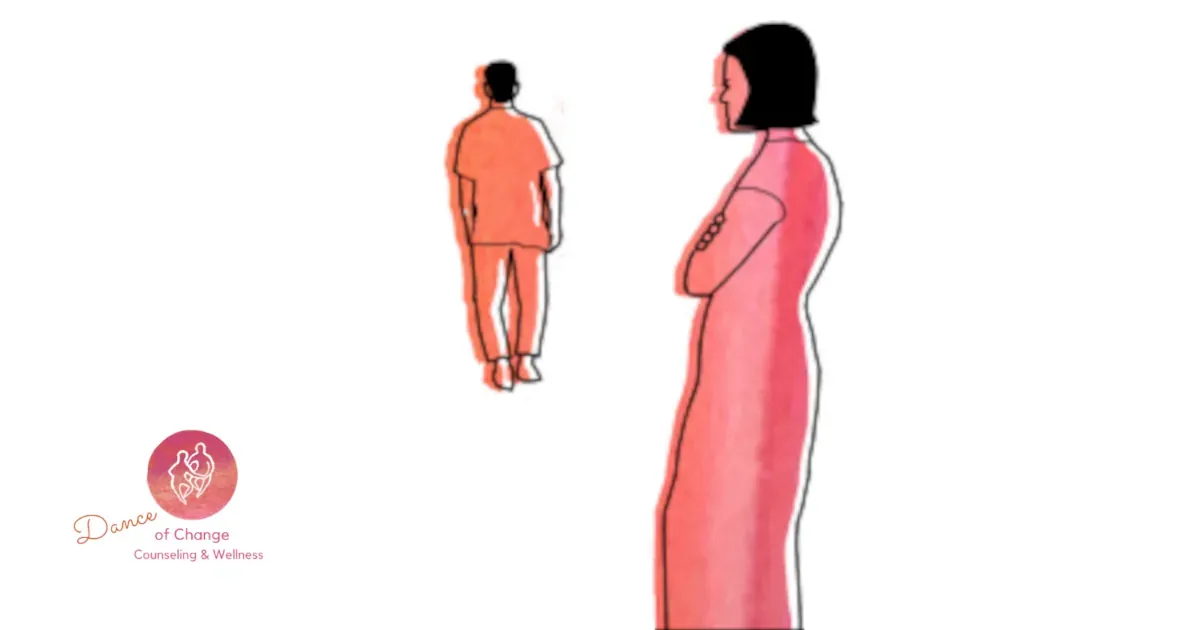
Jada and Pat came to me because of a sexless marriage. Jada sat on one end of the couch, her arms folded tightly across her chest and her eyes fixed on a distant point on the wall. Pat sat on the other end, his shoulders slumped and his gaze cast downward.
They had been married for more than 20 years and had raised two children together. From the outside, they had appeared to have built a successful marriage. They had rewarding careers, renovated a beautiful home together, and successfully launched their children into adulthood. Communication between, while not perfect, had seemed good enough. In their social circle they were even considered a mentor couple to others.
But, on the inside of their marriage they felt a growing distance that troubled them.
Resignation and Resentment
Jada’s lips tightened when I brought up the subject of sex. She shifted uncomfortably before speaking, her voice faint.
“It’s difficult for me to talk about that part of my life.” She did not look at Pat when she spoke. “ I just don’t feel like myself anymore. It’s like something inside me shut down. I know it would make Pat happy, if I had more desire..” She trailed off for a minute before composing herself. “… but I can’t manufacture something that’s not there. The fact that he wants it so badly only makes me feel worse. I know he’s not trying to pressure me, but I do feel pressured.”
Pat’s brow furrowed and he shifted uncomfortably on the couch.
“She thinks it’s just about the physical part, but it’s not. She doesn’t get how much I miss the connection we used to have. It’s about feeling close to her. I feel shut down all the time. It’s like I’m a failure as a husband. After so many rejections, I just stopped trying.”
Jada’s eyes brimmed with tears. Pat looked both angry and defeated.
Neither partner felt understood.
You Might Also Like: The Couples Dance: The 5 communication patterns the Keep you and your partner stuck
When Pursuit Becomes Pressure
Later, Jada described a familiar moment at home. Pat suggested that they go to bed early and “fool around a bit.” At the mere mention of the idea, Jada’s body tightened and she looked away. She quickly came up with a series of reasons it would not work. She had a deadline to finish, and besides, she was about to start her period.
She did this not because she did not love Pat, but because she could not locate her own desire next to his.
For Jada, it felt like a no-win choice: satisfy Pat’s strong desire for lovemaking and abandon herself, or protect herself and risk disappointing him, or worse, making him feel unloved. The choice seemed to be between love and self-protection. She could see no middle ground.
Pat felt disappointed, of course. But he also felt hurt and angry. It was obvious to him that Jada was pulling away again, and it was hard not to take that personally.
Was she no longer attracted to him? Had she decided there would be no more sex in the marriage and simply forgot to tell him? Did she really expect him to be okay with that?
Pat was pursuing intimacy because he missed Jada and longed to feel close to her. But the more he pursued, the more pressure she felt. The more she protected herself by pulling away, the more rejected and alarmed he became.
They had reached a physical and emotional standoff.
If you and your partner are caught between pressure, protection, and rejection, you do not have to remain unhappy. Or untangle the pattern alone. Our Marriage therapist are here to help.
Desire Differences Are Normal
There is no single normal or correct level of sexual desire. Couples vary tremendously in how often they want sex, for how long, in what manner, and what kinds of touch or sexual connection they enjoy. And often this changes over time.
Desire differences between two people are normal and an expected life stage in a long-term relationship. There is nothing inherently wrong or pathological about them. But it can create significant distress in both people.
How We Got Here
The problem is not just you, or your relationship. Most couples are affected by a common cultural belief: the romantic notion that two souls should automatically and seamlessly meld into one. This can quickly become a source of shame and pain when partners are not in sync physically and emotionally. Yet desire-differences are expected and can even be embraced when couples are able to take a different stance.
That is often the difficult part.
We carry a cultural idea that sex should happen automatically and should not need to be discussed. Shame and embarrassment make many couples reluctant to say what they want, what hurts, what turns them off or on, and what helps them experience pleasure. Many couples need to learn how to talk about intimacy in order to have satisfying sex and pleasure in their relationship. And they need to learn new skills that support their body-mind differences.
Desire discrepancy is common in long-term relationships. The difference itself is not necessarily the problem. The way partners understand and respond to it can determine whether it becomes an ongoing source of conflict.
When Sex Carries Different Meanings
For one partner, sex may become the primary way to feel loved, reassured, wanted, or connected. It may also offer needed stress or anxiety relief. For another, an invitation to have sex may begin to carry the expectation that they must perform, avoid disappointing their partner, or override their own experience.
Sometimes lovemaking also begins to feel like a cover-up. One partner may seek sex as a way to repair the distance, while the other feels that important emotional issues are being bypassed. Rather than having the hard conversations they need to have, they become caught between requests for intimacy and growing annoyance, resentment, or withdrawal.
The conflict is no longer simply about whether or not to have sex. Or how often and when. It becomes deeper than that.
Sexual initiation begins to represent love and rejection, closeness and abandonment, reassurance and pressure. Both partners may be trying to protect something important, but their attempts at protection keep hurting the person they love. This is often unintentional. What’s needed instead, is to create a sense of safety, without fusion, pressure or self-abandonment.
What Kills Desire?
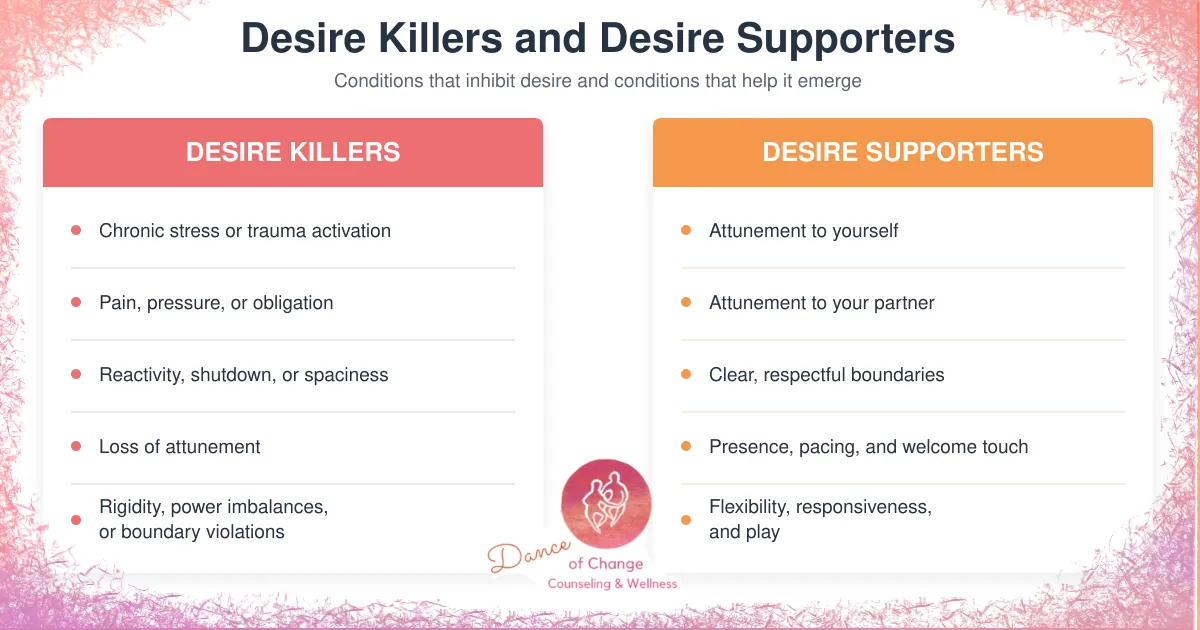
The sad truth is that a lot of couples can get so busy either trying to get their needs met or protecting themselves they don’t realize they are actually killing desire in the process. Some of the most common desire killers include:
- Chronic stress and trauma
- Power imbalances
- Fear
- Pressure for intimacy or feeling obligated
- Unwanted pain
- Resentment and unresolved relational conflict
When I asked Jada and Pat whether they experienced any of these desire killers, they both looked defeated. They could check off almost every one.
This was not good news. The task ahead of them was large. And yet, they remained committed.
They needed to address, and remove each obstacle one at a time in order to see what was possible. They could not demand that desire return. But they could begin changing the conditions that had made pleasure, vulnerability, and honest communication increasingly difficult.
For Jada and Pat, unwanted physical pain was also part of the story. Because pain can profoundly affect desire and bodily safety, it required immediate attention alongside their relational work. I discuss that part of their experience in Painful Sex and Lost Desire: Why Safety Must Come First.
The Higher-Desire Partner’s Dilemma
It is understandable for a higher-desire partner to want sex and to grieve its absence. Pat did not want a marriage without sex. Sexual intimacy was one of the primary ways he felt loved and connected to Jada.
His perspective mattered.
And without realizing it, he had been blocking the very desire he most wanted by preassuring Jada for sex. Pressure for sex is a guaranteed desire killer. When one partner feels pursued, obligated, or responsible for regulating the other through sex, it becomes increasingly difficult to locate genuine desire. Coercion, a significant power imbalance, or intimacy performed from obligation can inhibit desire even further.
Pat did not want that for himself or Jada. He did not want her to have sex with him out of fear, guilt, or obligation. And he did not want to feel trapped in a sexless marriage either. He needed space to express the loneliness, frustration, fear and dissapointment he had been carrying. And he needed to learn a different way. One that supported desire, rather than killed it.
Both he and Jada’s experiences needed room in the relationship.
Couples Therapy Should Not Create More Pressure
Couples therapy should never pressure either partner to have sex. The goal is to create enough honesty, safety, and freedom for both partners to understand their own desire, understand their partner’s desire, and discover whether they can build a mutually satisfying intimate relationship together.
In my work with couples, I do not see one person as the problem. I pay attention to verbal and nonverbal cues that tell me how each partner’s nervous system is organized around sex. I look at their unique arousal patterns and how those patterns affect desire. I listen for what sex and sexual refusal have come to mean to each person and how those meanings shape their bodies, hearts, and minds in the room.
Those reactions are not just ideas. They happen in the body, often before either person has words for them.
When couples can recognize the pattern without turning against each other, the standoff can begin to soften. The goal is not to force agreement or guarantee that both people will eventually want exactly the same things. It is to help them speak honestly, listen without threat, and explore what kind of intimate relationship can support both people.

Tips for Shifting the Dynamic Between You
- Right Place: Consider talking about intimacy outside the bedroom. Sometimes being in a different physical space can invite more safety and a different perspective.
- Right Time: Broach the subject of intimacy when you are both feeling emotionally regulated, not immediately after an initiation or refusal. Stop the conversation if either person becomes stressed or overwhelmed. Return to it when you are both in a better place.
- Own Your Own Experience: Describe your experience without interpreting your partner’s intentions or telling them what they should do differently.
- Get Curious: Ask your partner or spouse what helps them feel free, connected, relaxed, and unpressured. Their answers can help both of you better understand the conditions that support intimacy and pave the way to a better future together.
- Create a Blame-Free Zone: Desire differences are normal. Treat them as a shared relationship challenge rather than evidence that one person is at fault. They are also not proof that the relationship or marriage itself is broken.
- Don’t Wait to Get Help: Many couples wait until sexual disconnection has become deeply entrenched and has caused considerable damage to the relationship. If conversations about intimacy repeatedly lead to pressure, blame, withdrawal, or threats to end the marriage, it’s time to get help. Professional support can help you and your spouse address the pattern before it becomes entrenched.
Schedule a Free Couples Consultation
Frequently Asked Questions
Q: Will you take sides?
A: In couples therapy, I do not take sides. I help both partners address the barriers that put them in opposition in the first place. I do not believe one person has to lose for the other to win. We look for common ground that benefits the couple as a whole.
Q: Will you tell us to schedule sex?
A: Not automatically. I customize my recommendations based on what each couple uniquely needs and avoid blanket formulas. Some couples benefit from scheduling time for intimacy; others do not. I am more interested in helping you discover what works for you as a couple in your particular relationship.
Q: Will couples therapy pressure us to have sex?
A: No. Couples therapy should create more freedom, honesty, and choice, not additional pressure. The work may involve understanding desire differences, addressing pain, changing how you communicate, or exploring mutually welcome forms of touch and intimacy. Neither partner should be required to override their body or consent to prove love.
Are you Struggling with a Sexless Marriage?
If conversations about sex end in pressure, rejection, anger, defensiveness, or silence, neither partner has to become the enemy.
I provide sex-positive, trauma-sensitive, attachment-based, somatic marriage and couples therapy in St. Louis for couples who want to understand what has come between them and explore whether they can build a mutually satisfying intimate relationship.
Schedule a free couples therapy consultation to explore whether working together may be a good fit.
We are located in St Louis, Missouri and serve couples in the following communities: Webster Groves, Kirkwood, Crestwood, Maplewood, Brentwood, Rockhill, Richmond Heights, Clayton, Shrewsbury, Lindenwood, Ladue, Central West End and the surrounding areas.
Give us a call or text us at: (314) 827-5448
We offer in person sessions in our office in Saint Louis, MO in Webster Groves as well as video (Telehealth) session for anyone located in the state of Missouri