
Not All EMDR Therapy Is the Same
EMDR has become one of the best-known treatments for trauma and PTSD. But two therapists trained in EMDR may practice it very differently.
I have worked with people who made remarkable progress with EMDR and others who came away believing it simply did not work for them. Sometimes the difference was not EMDR itself. The treatment did not adequately account for the person’s body-mind or nervous system.
This becomes especially important when you have lived through chronic, childhood, developmental, or relational trauma. There may not be one terrible event that you can neatly identify and process. There may be dozens. Some may have happened before you had words to describe them.
This is where our approach to EMDR is different.
We integrate EMDR with Somatic Experiencing (SE) and other body-based approaches. That does not simply mean asking you what you feel in your body while doing EMDR. It means knowing how to read the nervous system, recognize when your body is telling us something your words are not, and help you gradually develop the stability and body awareness necessary for deeper trauma work.
Curious if we are a good fit for you?
Sometimes EMDR is exactly where we begin.
And sometimes it isn’t.
Knowing the difference matters.
When Standard EMDR May Not Be Enough
EMDR can work especially well when there is a recognizable traumatic experience connected to present-day distress: an accident, assault, frightening medical procedure, loss, or other event with a fairly clear before and after.
Complex trauma is often messier.
Perhaps you grew up with unpredictability, chronic criticism, neglect, fear, or feelings too large for a child to manage alone. Or perhaps nothing in your history fits neatly into the category of “trauma.”
You may even tell me, “My childhood was fine.”
Yet while you are talking, I may notice your shoulders becoming rigid. Your breathing changes. Or you lose your train of thought. Perhaps you laugh while describing something painful. Or suddenly you cannot feel much of anything.
Your words are giving me one piece of information.
Your nervous system may be giving me another.
That difference matters.
What If You Can’t Feel Your Body?
Somatic therapy has become increasingly popular, and with that has come a misunderstanding about what it actually involves.
Asking “What do you notice in your body?” does not make therapy somatic.
Many people with chronic trauma genuinely do not know how to answer that question. You may recognize only obvious sensations or notice what is happening once you are already overwhelmed. Turning inward may leave you anxious, confused, or completely blank.
I don’t assume you already possess the body awareness necessary for somatic trauma work.
We help you build it.
Gradually, you begin learning the language of your own nervous system: subtle changes in breathing, tension, posture, movement, emotion, impulses, and attention. As a somatic therapist, I am also watching these shifts. They help me recognize when we can move closer to difficult material, when we need to slow down, and when you may be disappearing from the room while still sitting right in front of me.
For some people, this is the necessary first work.

Sometimes Your Mind and Your Body Tell Different Stories
EMDR remains, in important ways, a narrative-driven therapy. Traditional EMDR asks us to identify a target experience along with an image, emotion, sensation, and beliefs associated with it.
But early trauma does not always arrive as a coherent story.
Experiences from infancy and early childhood occurred before you could organize them into language. Later experiences may have been fragmented, minimized, forgotten, or understood through the eyes of the child you were.
Sometimes I hear:
“My father yelled, but he never hit us.”
“My mother did the best she could.”
“It really wasn’t that bad.”
All of those statements may be true.
And your body may still become very quiet and very small when someone is angry with you.
The goal isn’t to decide your body is right and your story is wrong. It is to become curious about the distance between them and, when necessary, begin to mend that gap.
To begin to pry open the rusty 300-pound door separating you from parts of yourself without forcing it open all at once.
Why We Combine Somatic Experiencing and EMDR
EMDR gives us a structured method for processing experiences that remain emotionally charged. Somatic Experiencing gives me another set of clinical skills: observing how your autonomic nervous system responds in real time and helping you work with those responses in manageable pieces.
Before asking your system to process something painful, I want to know what happens when we move toward it.
Do you become agitated? Do you disappear? Do you become extraordinarily articulate while becoming increasingly disconnected from everything below your neck? Also, I want to know how trauma is showing up in your most important relationships.
These observations help determine what happens next.
Sometimes we use EMDR. Sometimes we work somatically. Often we move between the two.
Good trauma therapy is not about fitting you into a favorite treatment. It is knowing the right tool, the right dose, and the right pace.
EMDR: What It Is and How It Works
EMDR stands for Eye Movement Desensitization and Reprocessing. It is based on the idea that difficult experiences can remain insufficiently processed, leaving memories connected to intense emotions, beliefs, sensations, and present-day triggers.
EMDR uses bilateral stimulation, such as alternating eye movements, sounds, or tapping, while you work with aspects of a traumatic experience. The therapist periodically pauses to notice what emerges and guide the processing.
You do not have to recount every detail of what happened. The purpose is also not to repeatedly relive the trauma. We are helping something that has remained unfinished begin to move.
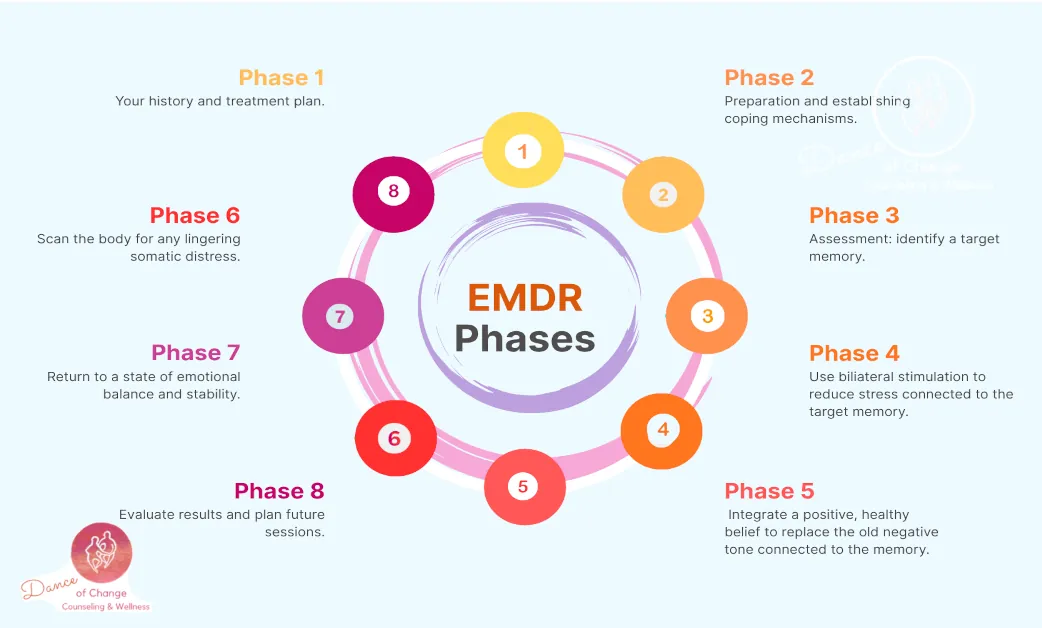
The Eight Phases of EMDR
EMDR follows eight phases, but eight phases do not mean eight sessions.
- History and planning: We understand your history, current difficulties, and treatment goals.
- Preparation: A target memory is often identified. You learn body-based calming skills to feel safe. Complex trauma work often happens here.
- Assessment: We identify the experience and the emotions, sensations, thoughts, and beliefs connected to it.
- Desensitization: You focus on the target memory while we use bilateral stimulation to lower the distress and body sensations linked to it. This is done while attending to what emerges and how your body responds.
- Installation: We help you strengthen the positive belief you chose to replace the old negative belief until it feels true.
- Body Scan: This is done while attending to what emerges and how your body responds.
- Closure: A therapist helps you safely return to a state of emotional balance.
- Reevaluation: We return to previous work, assess what has changed, and determine what needs attention next.
EMDR Therapy FAQ
Is EMDR a quick fix?
No. Quick fixes are not a thing in therapy. Some people with a single-event trauma experience substantial improvement relatively quickly (meaning 12 sessions or less). Chronic, developmental, and relational trauma often require a slower process. The goal is not to race toward the worst thing that ever happened and process it as quickly as possible. Sometimes healing means taking one small step at a time while developing capacities that were never safe or possible before.
Will EMDR help with PTSD?
Yes, EMDR is often helpful. It has substantial research support for treating PTSD and can be particularly useful when specific experiences continue to cause flashbacks, nightmares, avoidance, or strong emotional and physical reactions. But a PTSD diagnosis does not tell us exactly how treatment should proceed. Your history, current stability, type of trauma, personality and nervous system responses all help determine whether we begin with EMDR processing or something else.
I have complex PTSD. Is EMDR, Brainspotting or Somatic Experiencing Better?
Neither is automatically better. Some people with complex trauma, may need some preparatory tools in order to to notice their internal experience without becoming overwhelmed or shutting down. Somatic Experiencing allows us to work in smaller pieces while tracking what your nervous system can actually manage. For some clients, SE creates the foundation for later EMDR or brainspotting. For others, we integrate these throughout treatment based on a client’s unique needs.
Can EMDR help with panic?
EMDR may help with panic disorder, anxiety and phobias, particularly when panic is connected to frightening experiences or specific triggers, although its evidence base is stronger for PTSD. Two people can both report panic attacks while having very different processes driving them. Rather than automatically applying a generic panic protocol, it’s often helpful to understand the nature of your panic attacks
Is EMDR useful for every mental health problem?
No. EMDR was developed as a trauma treatment and has its strongest evidence base for PTSD. Although clinicians use it for other concerns, that does not make every problem an EMDR target. Sometimes another approach makes more sense.
Is EMDR appropriate for children?
Yes, EMDR can be adapted for children and adolescents in combination with other play-based therapies. Children may communicate distress through nightmares, play, behavior, withdrawal, anxiety, or changes in relationships rather than a coherent story. Depending on the child, EMDR may be integrated with play, expressive arts, movement, Somatic Experiencing, or family therapy so treatment matches the child’s developmental needs.
Somatic EMDR Therapy in St. Louis
At Dance of Change Counseling, we integrate EMDR with Somatic Experiencing and other trauma approaches rather than assuming one protocol is right for every nervous system.
The work may involve processing a traumatic memory. It may mean learning to recognize internal signals before they become a roar. Or slowly softening the protective shell that has kept you safe but small.
Sometimes it means discovering the middle ground: the place where you do not have to disappear or become impenetrable. Where you can be awkward and right-sized. Capable of misunderstanding and being misunderstood, but also capable of its opposite.
Looking for EMDR Therapy in St. Louis?
We off er EMDR for the whole family. Request an appointment with a therapist now. It’s free and assures that we are a good fit for you.