All posts by Danielle Kiesler

The Couple Bubble: Your Complete Guide to Protecting Your Marriage.

What is a couples bubble?

A “couple bubble” is a concept in relationship psychology that refers to the creation of a safe and secure environment between partners. In this environment, both individuals prioritize each other’s well-being, safety, and emotional security above all else. This involves mutual support, trust, and a commitment to protecting the relationship from external stressors and conflicts.

The term “couple bubble” was coined by Dr. Stan Tatkin, a psychotherapist and author who specializes in attachment theory and its application to adult relationships. He introduced the concept in his book “Wired for Love: How Understanding Your Partner’s Brain and Attachment Style Can Help You Defuse Conflict and Build a Secure Relationship.”

Why a couple bubble is important to your marriage

Dr. Tatkin emphasizes that the couple bubble is essential for creating a secure and resilient partnership. Without that level of protection an relationship may not last. Marriages can become vulnerable to both internal and external stressors. I like to think of a Couples Bubble as a kind of shield that protects the couples from harm and danger. Yet, the shield can also become permeable when needed to let in support, resources and information from the outside. The combination of both strength and flexibility are important qualities in marriage.

related post: How to Get the Most Out Of Couples Counseling

A marriage with a strong couples bubble (with specific examples)

To help understand how the concept of the couples bubble gets put into practice, let’s look at some examples. We will look at a fictional couple called Krya and Sam. Although they are fictional this couple illustrates how real couples can and do protect their marriage. how Kyra and Sam can protect their couple bubble, ensuring a secure, trusting, and intimate relationship.

10 signs that your couple bubble is strong:

1. Regular, open communication is the norm in your marriage

Kyra and Sam set aside 15 minutes every evening to talk about their day and share their feelings. When Kyra feels stressed about work, she tells Sam, and he listens attentively without interrupting. When Sam feels frustrated with a colleague he tells Kyra about it. This routine helps them maintain understanding and trust, ensuring they are aware of each other’s emotional state and needs. These kinds of open, honest and transparent communication are not always easy. Nor, do they come naturally to most couples. But the good news is that great communication can be learned. This is true whether you are a new couple or have been married for decades. With a little practice,  courage and vulnerability

2. You prioritize each other

When Sam is offered a job that requires frequent travel, he discusses it with Kyra before making a decision, considering how it will affect their relationship. They decide together that he will take the job but limit travel to once a month. By making decisions together, they demonstrate that their relationship is a priority. This practice also sends the clear message that they value each other’s needs and input. When Kyra is asked to join an after hours work committee, she reflects on the impact on the marriage and checks it out with Sam.

3. You are both good at setting boundaries

Kyra’s mother frequently drops by unannounced. In the past this was a source of stress for the couple. But Kyra and Sam agreed on specific visiting hours and Kyra communicated this boundary to her mom. With a little practice and reinforcement on their part, it is no longer an issue. They also establish that Sundays are their private time, free from family visits. Setting boundaries protects their intimacy and ensures that external influences do not disrupt their relationship.

4. You and your partner express appreciation daily

Sam regularly thanks Kyra for her support and efforts. Whether it’s working hard to provide for their family or organizing their finances. Kyra often tells Sam how much she appreciates his humor and the little things he does around the house. He also happens to be an excellent chef and she praises his creations regularly. Sam publicly brags about Kyra’s “fun”personality and courage to his friends and coworkers. These regular expressions of gratitude reinforce positive feelings and support, making both partners feel valued.

5. Your marriage is characterized by physical affection

Kyra and Sam make it a point to hug each other every morning before leaving for work and cuddle on the couch while watching TV in the evenings. Regular physical touch strengthens their emotional bond and helps maintain a sense of closeness. Both Sam and Kyra touch, kiss and embrace each other regularly. Although scheduling sex is not something that works for all couples, it works for them. Physical affection tends to come easily in the early stages of a relationship, but requires concerted effort the longer a couple has been together.

Couples Therapy

6. Your marriage is supportive

When Kyra is overwhelmed with a project deadline, Sam takes over some of her household chores and offers words of encouragement. When Sam is dealing with a difficult situation with his dad, Kyra listens and offers emotional support. If one partner is ill or has low energy, the other often picks up the slack without complaint or the need for an immediate pay back. When both Kyra and Stan are struggling and/or their kids are struggling they are able to talk it out and come up with a plan together. By offering support during stressful times, they demonstrate to themselves and each other their commitment.  Their bond gets reinforced and strengthened with each of these experiences.

7. You spend quality time together

Kyra and Sam schedule a date night every Friday where they try a new restaurant or engage in a fun activity like bowling. They also enjoy cooking dinner together on weekends. Sam likes to surprise Kyra with new experience. Last month he scheduled a cooking class together. Another time they enjoyed taking sailing lessons. Spending quality time together helps them reconnect and creates shared experiences that strengthen their relationship.

8. You fight well together

When Kyra and Sam have a disagreement, they resolve conflicts constructively. They avoid shouting and name-calling. Instead, they sit down and calmly discuss their perspectives, seeking to understand each other. Neither stops until both feel heard. When possible, they work to find a solution that works for both. This kind of constructive conflict resolution strengths their couples bubble. It also prevents resentment and maintains harmony in their relationship.

9. You practice forgiveness in your marriage

When Sam forgets their anniversary, Kyra is hurt but decides to talk about her feelings instead of holding a grudge. Sam apologizes sincerely, and Kyra forgives him, acknowledging that everyone makes mistakes. Practicing forgiveness helps them move past hurt feelings. It also helps repair old wounds and prevent possible trauma. Forgiveness makes the relationship stronger and resilient.

10. Your marriage has specific supportive rituals in place

Kyra and Sam have a tradition of having breakfast in bed every Sunday morning. Because of his work schedule, Sam often arrives home before Kyra. So when Kyra comes home, she makes a point of seeking Sam out, hugging and kissing him as a way of greeting him. They also celebrate their wedding anniversary by revisiting the place where they first met. These shared rituals and traditions provide a sense of stability and continuity, that reinforces their bond and creates cherished memories.

Looking for a good couples therapist or marriage therapist?

Contact our office to get connected to an experienced Licensed Marriage and Family Therapists who can help turn your relationship around.

We are located in St Louis, Missouri and serve couples in the both Saint Louis City and Saint Louis County. This includes the following communities: Maplewood, Webster Groves, Kirkwood, Crestwood, Maplewood, Brentwood, Rockhill, Richmond Heights, Clayton, Shrewsbury, Lindenwood, Ladue, Central West End and the surrounding areas.

Give us a call at: (314) 827-5448 or email us at admin@danceofchange.com

We offer in person sessions in our office in Saint Louis, MO in Webster Groves as well as video (Telehealth) session for anyone located in the state of Missouri
The Sexless Marriage: One Couple’s Story

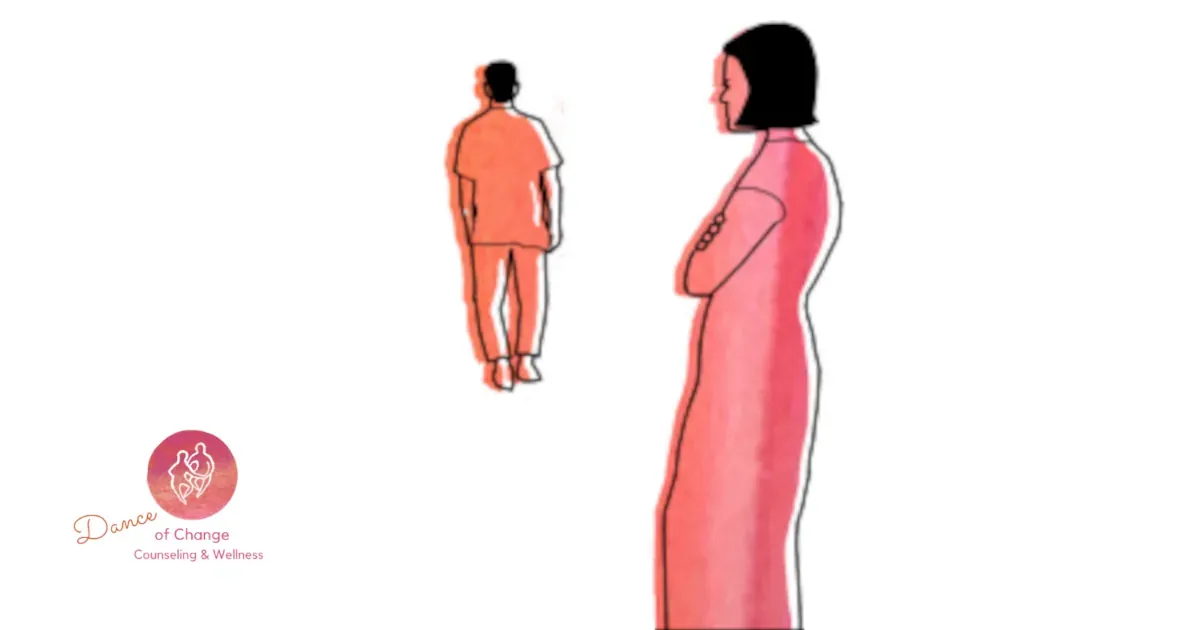
Illustration of partners turned away from each other, showing emotional distance in a sexless marriage.

By Danielle Kiesler, MA, LMFT, SEP   Danielle Kiesler is a Licensed Marriage and Family Therapist with 21 years of experience. She is a PACT Level II-trained couples therapist, an advanced-level Somatic Experiencing consultant, and has completed Level II sex therapy training through the Institute for Relational Intimacy, as well as additional coursework through the American Association of Sexuality Educators, Counselors and Therapists (AASECT). 

Jada and Pat are a composite couple. Their names, dialogue, circumstances, and identifying details have been created or substantially altered to protect client privacy.

Jada and Pat came to me because of a sexless marriage. Jada sat on one end of the couch, her arms folded tightly across her chest and her eyes fixed on a distant point on the wall. Pat sat on the other end, his shoulders slumped and his gaze cast downward.

They had been married for more than 20 years and had raised two children together. From the outside, they had appeared to have built a successful marriage. They had rewarding careers, renovated a beautiful home together, and successfully launched their children into adulthood. Communication between, while  not perfect, had seemed good enough. In their social circle they were even considered a mentor couple to others. 

But, on the inside of their marriage they felt a growing distance that troubled them.

Resignation and Resentment

Jada’s lips tightened when I brought up the subject of sex. She shifted uncomfortably before speaking, her voice faint.

“It’s difficult for me to talk about that part of my life.” She did not look at Pat when she spoke. “ I just don’t feel like myself anymore. It’s like something inside me shut down. I know it would make Pat happy, if I had more desire..” She trailed off for a minute before composing herself. “… but I can’t manufacture something that’s not there. The fact that he wants it so badly only makes me feel worse. I know he’s not trying to pressure me, but I do feel pressured.”

Pat’s brow furrowed and he shifted uncomfortably on the couch.

“She thinks it’s just about the physical part, but it’s not. She doesn’t get how much I miss the connection we used to have. It’s about feeling close to her. I feel shut down all the time. It’s like I’m a failure as a husband. After so many rejections, I just stopped trying.”

Jada’s eyes brimmed with tears. Pat looked both angry and defeated. 

Neither partner felt understood.

You Might Also Like: The Couples Dance: The 5 communication patterns the Keep you and your partner stuck

When Pursuit Becomes Pressure

Later, Jada described a familiar moment at home. Pat suggested that they go to bed early and “fool around a bit.” At the mere mention of the idea, Jada’s body tightened and she looked away. She quickly came up with a series of reasons it would not work. She had a deadline to finish, and besides, she was about to start her period.

She did this not because she did not love Pat, but because she could not locate her own desire next to his.

For Jada, it felt like a no-win choice: satisfy Pat’s strong desire for lovemaking and abandon herself, or protect herself and risk disappointing him, or worse, making him feel unloved. The choice seemed to be between love and self-protection. She could see no middle ground.

Pat felt disappointed, of course. But he also felt hurt and angry. It was obvious to him that Jada was pulling away again, and it was hard not to take that personally.

Was she no longer attracted to him? Had she decided there would be no more sex in the marriage and simply forgot to tell him? Did she really expect him to be okay with that?

Pat was pursuing intimacy because he missed Jada and longed to feel close to her. But the more he pursued, the more pressure she felt. The more she protected herself by pulling away, the more rejected and alarmed he became.

They had reached a physical and emotional standoff.

If you and your partner are caught between pressure, protection, and rejection, you do not have to remain unhappy. Or untangle the pattern alone. Our Marriage therapist are here to help. 

Book A Private Consult Call

Desire Differences Are Normal

There is no single normal or correct level of sexual desire. Couples vary tremendously in how often they want sex, for how long, in what manner, and what kinds of touch or sexual connection they enjoy. And often this changes over time. 

Desire differences between two people are normal and an expected life stage in a long-term relationship. There is nothing inherently wrong or pathological about them. But it can create significant distress in both people. 

How We Got Here

The problem is not just you, or your relationship. Most couples are affected by a common cultural belief: the romantic notion that two souls should automatically and seamlessly meld into one.  This can quickly become a source of shame and pain when partners are not in sync physically and emotionally. Yet desire-differences are expected and can even be embraced when couples are able to take a different stance.

That is often the difficult part.

We carry a cultural idea that sex should happen automatically and should not need to be discussed. Shame and embarrassment make many couples reluctant to say what they want, what hurts, what turns them off or on, and what helps them experience pleasure. Many couples need to learn how to talk about intimacy in order to have satisfying sex and pleasure in their relationship. And they need to learn new skills that support their body-mind differences. 

Desire discrepancy is common in long-term relationships. The difference itself is not necessarily the problem. The way partners understand and respond to it can determine whether it becomes an ongoing source of conflict.

When Sex Carries Different Meanings

For one partner, sex may become the primary way to feel loved, reassured, wanted, or connected. It may also offer needed stress or anxiety relief. For another, an invitation to have sex may begin to carry the expectation that they must perform, avoid disappointing their partner, or override their own experience.

Sometimes lovemaking also begins to feel like a cover-up. One partner may seek sex as a way to repair the distance, while the other feels that important emotional issues are being bypassed. Rather than having the hard conversations they need to have, they become caught between requests for intimacy and growing annoyance, resentment, or withdrawal.

The conflict is no longer simply about whether or not to have sex. Or how often and when. It becomes deeper than that. 

Sexual initiation begins to represent love and rejection, closeness and abandonment, reassurance and pressure. Both partners may be trying to protect something important, but their attempts at protection keep hurting the person they love. This is often unintentional. What’s needed instead,  is to create a sense of safety, without fusion, pressure or self-abandonment.  

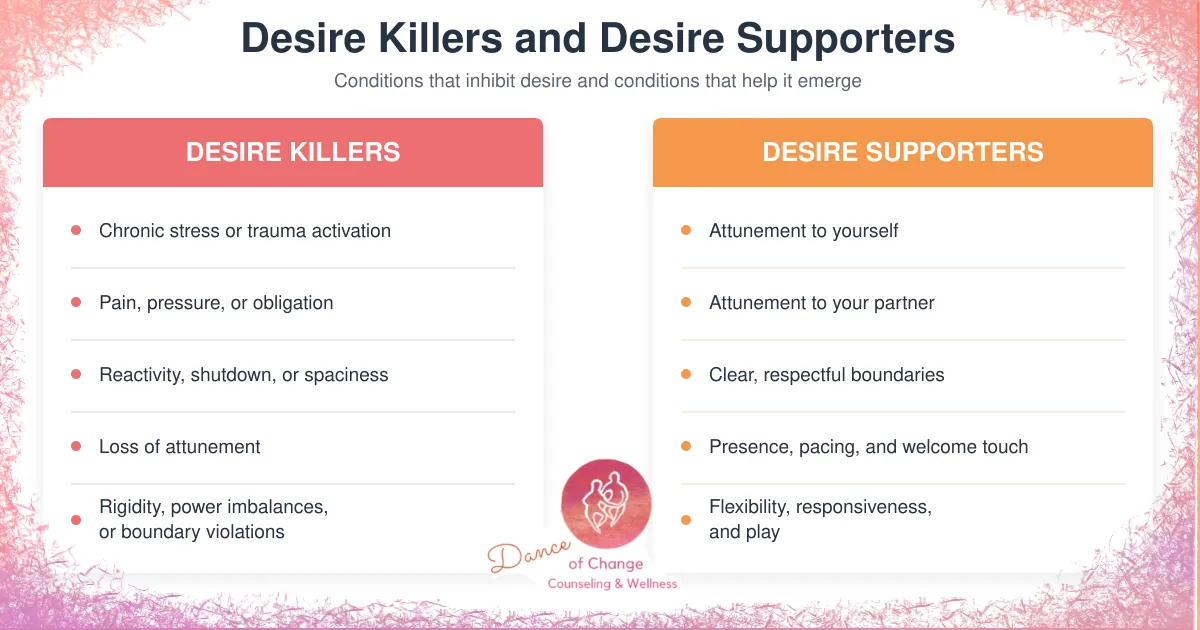
Infographic comparing desire killers like stress and pressure with supporters like attunement, boundaries, touch, and play.

What Kills Desire?

The sad truth is that a lot of couples can get so busy either trying to get their needs met or protecting themselves they don’t realize they are actually killing desire in the process. Some of the most common desire killers include:

When I asked Jada and Pat whether they experienced any of these desire killers, they both looked defeated. They could check off almost every one.

This was not good news. The task ahead of them was large. And yet, they remained committed.

They needed to address, and remove each obstacle one at a time in order to see what was possible. They could not demand that desire return. But they could begin changing the conditions that had made pleasure, vulnerability, and honest communication increasingly difficult.

For Jada and Pat, unwanted physical pain was also part of the story. Because pain can profoundly affect desire and bodily safety, it required immediate attention alongside their relational work. I discuss that part of their experience in Painful Sex and Lost Desire: Why Safety Must Come First.

The Higher-Desire Partner’s Dilemma

It is understandable for a higher-desire partner to want sex and to grieve its absence. Pat did not want a marriage without sex. Sexual intimacy was one of the primary ways he felt loved and connected to Jada.

His perspective mattered.

And without realizing it, he had been blocking the very desire he most wanted by preassuring Jada for sex. Pressure for sex is a guaranteed desire killer. When one partner feels pursued, obligated, or responsible for regulating the other through sex, it becomes increasingly difficult to locate genuine desire. Coercion, a significant power imbalance, or intimacy performed from obligation can inhibit desire even further.

Pat did not want that for himself or Jada. He did not want her to have sex with him out of fear, guilt, or obligation. And he did not want to feel trapped in a sexless marriage either. He needed space to express the loneliness, frustration, fear and dissapointment he had been carrying. And he needed to learn a different way. One that supported desire, rather than killed it.

Both he and Jada’s experiences needed room in the relationship.

Couples Therapy Should Not Create More Pressure

Couples therapy should never pressure either partner to have sex. The goal is to create enough honesty, safety, and freedom for both partners to understand their own desire, understand their partner’s desire, and discover whether they can build a mutually satisfying intimate relationship together.

In my work with couples, I do not see one person as the problem. I pay attention to verbal and nonverbal cues that tell me how each partner’s nervous system is organized around sex. I look at their unique arousal patterns and how those patterns affect desire. I listen for what sex and sexual refusal have come to mean to each person and how those meanings shape their bodies, hearts, and minds in the room.

Those reactions are not just ideas. They happen in the body, often before either person has words for them.

When couples can recognize the pattern without turning against each other, the standoff can begin to soften. The goal is not to force agreement or guarantee that both people will eventually want exactly the same things. It is to help them speak honestly, listen without threat, and explore what kind of intimate relationship can support both people.

Marriage Counseling

Tips for Shifting the Dynamic Between You

  • Right Place: Consider talking about intimacy outside the bedroom. Sometimes being in a different physical space can invite more safety and a different perspective.
  • Right Time: Broach the subject of intimacy when you are both feeling emotionally regulated, not immediately after an initiation or refusal. Stop the conversation if either person becomes stressed or overwhelmed. Return to it when you are both in a better place.
  • Own Your Own Experience: Describe your experience without interpreting your partner’s intentions or telling them what they should do differently.
  • Get Curious: Ask your partner or spouse what helps them feel free, connected, relaxed, and unpressured. Their answers can help both of you better understand the conditions that support intimacy and pave the way to a better future together
  • Create a Blame-Free Zone: Desire differences are normal. Treat them as a shared relationship challenge rather than evidence that one person is at fault. They are also not proof that the relationship or marriage itself is broken.
  • Don’t Wait to Get Help: Many couples wait until sexual disconnection has become deeply entrenched and has caused considerable damage to the relationship. If conversations about intimacy repeatedly lead to pressure, blame, withdrawal, or threats to end the marriage, it’s time to get help. Professional support can help you and your spouse address the pattern before it becomes entrenched.

Schedule a Free Couples Consultation

Frequently Asked Questions

Q: Will you take sides?

A: In couples therapy, I do not take sides. I help both partners address the barriers that put them in opposition in the first place. I do not believe one person has to lose for the other to win. We look for common ground that benefits the couple as a whole. 

Q: Will you tell us to schedule sex?

A: Not automatically. I customize my recommendations based on what each couple uniquely needs and avoid blanket formulas. Some couples benefit from scheduling time for intimacy; others do not. I am more interested in helping you discover what works for you as a couple in your particular relationship.

Q: Will couples therapy pressure us to have sex?

A: No. Couples therapy should create more freedom, honesty, and choice, not additional pressure. The work may involve understanding desire differences, addressing pain, changing how you communicate, or exploring mutually welcome forms of touch and intimacy. Neither partner should be required to override their body or consent to prove love.

Are you Struggling with a Sexless Marriage?

If conversations about sex end in pressure, rejection, anger, defensiveness, or silence, neither partner has to become the enemy.

Book A Free Private Call

I provide sex-positive, trauma-sensitive, attachment-based, somatic marriage and couples therapy in St. Louis for couples who want to understand what has come between them and explore whether they can build a mutually satisfying intimate relationship.

Schedule a free couples therapy consultation to explore whether working together may be a good fit.


We are located in St Louis, Missouri and serve couples in the following communities:  Webster Groves, Kirkwood, Crestwood, Maplewood, Brentwood, Rockhill, Richmond Heights, Clayton, Shrewsbury, Lindenwood, Ladue, Central West End and the surrounding areas.

Give us a call or text us at: (314) 827-5448

We offer in person sessions in our office in Saint Louis, MO in Webster Groves as well as video (Telehealth) session for anyone located in the state of Missouri

Anxiety Counseling: “I can’t keep up with this pace!” One woman’s story

Anxiety Counseling

I sat across from Alysa as she leaned back in her chair and began to rub her temples. Her large gold earrings lifted up and down in time with the rhythm as she closed her eyes for a moment. She had come to me as a counselor for anxiety counseling.

“I can’t keep up with this pace” she said.

After giving her a little time to decompress I spoke softly, “You’ve mentioned this to me before”

She laughed nervously and her eyes popped open for a minute.

“I told my son, he needed to pay more attention to his body” “ You know, not go full throttle in basketball practice. He could re-injury himself”

Her eyes looked down for a moment. “I’m such a hypocrite. I really need to follow my own advice.” I give good advice!” She said, Laughing.

We both smiled and I nodded ” Yes you do”


Why we don’t Listen to Our Own Advice

When we are under stress the emotional centers of our brain kick in. Then stress & anxiety run the shows. We then move into a survival response of flight. More reactive, less able to think clearly.
“So, if you were to give yourself some good advice what might you say? Would it be the same that you gave your son…to listen to your body?

She looked thoughtful as she stared out out the office.”Yeah, Probably. I don’t always give myself advice. But sometimes I do. And even when I do, I don’t follow it.”

“Why not?”

She leaned into the arm chair as though trying to hold herself up. Then let out a long sigh.

“I’ve lived my whole life, in overdrive. I go 100 miles an hour. It’s what I’m known for. I’m good at it. My whole life has been about not listening to my body.”

“My whole life has been about not listening to my body”.

The Price we Pay for Speed

As a senior VP in her company Alysa had a lot on her plate. She had worked hard to lead her team in efforts to deliver a product with a quick turn around and she was good at it. She has developed a reputation among her colleagues for being a fast and decisive leader. Yet it came at a cost. And the costs were starting to mount up. Her physical and mental complaints were many: chest pains, headaches, back pain, TMJ, irritable bowel syndrome as well as on going stress and anxiety. And on top of that she had started to feel distant, more irritated with her husband. Her marriage was faltering.

Give me a break!

” I need a friggin break! My body just can’t keep up the way it used to. And I feel tired a lot.”

So do you think that you will take this 30 minute break?

She paused in her face. Got still.

She started to speak and then stopped herself. You’re hesitating quite a bit. I said,

“It’s just in the past, when I’ve tried to take a break, I’ve not done it. So I don’t want to hold myself to it. I don’t want to say I will, but then not do it. It’s the follow through. That’s hard for me.”

When Stress & Anxiety Run the Show

The truth is we live in a fast past culture. Many of us run on anxiety.
Adrenaline can be a high. It can be addictive. Plus, our own
family of origin patterns reinforces it. We are wired to respond quickly. Overvalued for our performance. Undervalued for who we are when at rest.
Suffering from job burn out? You’re in need of anxiety counseling.

Get Anxiety Counseling

An experienced anxiety counselor or coach can help by using anxiety counseling and other approaches. Contact our office we’ve got you covered. We will help coach you in a better direction.

We are located in St Louis, Missouri and serve people in the following communities: Webster Groves, Kirkwood, Crestwood, Maplewood, Brentwood, Rockhill, Richmond Heights, Clayton, Shrewsbury, Lindenwood, Ladue, Central West End and the surrounding areas.

Give us a call at: (314) 827-5448 , email us at admin@danceofchange.com or https://danceofchange.com/book-an-appointment/

We offer in video (Telehealth) session for anyone.

My Takeaways from my Interview with Dr. Steve Terrell

[su_youtube url=” https://youtu.be/eGDtKDCpp1Q”]

Who is Steve?

I had the good fortune of getting to interview Dr. Steve Terrell, a leading expert in the field of developmental trauma.  He has performed more than 25,000 individual transforming touch sessions.  Steve has developed his own touch-based training called Transforming the Experience-Based Brain.  It’s a regulation based approach to working developmental trauma that he has taught to thousands of students from around the world.  And he is hosting one of these trainings in STL in Sept 2023!

He’s also still a practicing therapist in Texas at the Austin Attachment and Counseling Center in Austin, Texas. Steve has written two books.  One is called Nurturing Resilience, a book for therapists about helping clients move through developmental trauma that he wrote with Kathy Kain.  And the other is a new release called TEB LIKE 123, a book for parents and children that Steve coauthored with Shiri Sher.

Why Touch is Important in Healing Developmental Trauma

Touch has the power to heal even a very disorganized, nervous system.  It can be used as a regulation intervention at any age.  We never grow out of our need for touch.  Touch is one of the earliest forms of nurturing and regulation, starting from infancy.

Developmental trauma is anything that interrupts the development of the human from conception on.  Usually this shows up in a person’s behavior.

Shock Trauma vs. Developmental Trauma

Shock trauma is what we hear most about when we think of post-traumatic stress disorders.  It is when a traumatic event occurs and after that event your life is different.  With shock trauma often all we have is a memory of the event and the desire to return to life before the event.  There is a story, image, or narrative.

Conversely, in developmental trauma we don’t know what it was like before.  Often there is no memory of it.   Nobody has that information, so it’s like we’re working in the dark.  That’s why a therapist’s ability to hold space is so important. Being present and building trust in the relationship are key.  So is, letting go of the need to be the expert.

How to Work with Touch even in a Virtual Space

You can learn and work with touch intentionally using the same protocols that you would if you were in person.  The pandemic taught us that it actually works really well.

The Language of Touch

Before using physical touch it’s important to use collaborative language.  Instead of, I’m gonna do this to you. We are gonna do this. We are going to allow this to expression.  Co-regulation can only happen through collaboration and only in the context of safety.

For Body Workers

It is important to keep in mind that you can listen no matter how you’re trained. It doesn’t matter what school you went to. Massage and body workers oftentimes feel like they’re not doing enough. They want their client to leave happy. They want them to leave like “oh, that really felt good”.  I really try to get a release of some kind.  Your client doesn’t need to feel great when they’re done. What you want to say is “I’m going to support you even if you feel bad.”  That’s the goal.  You don’t need to fix anybody.

How  the Transforming the Experienced-Based Brain (TEB) training works

There are three modules that build on each other.  Each takes three and a half days.  All the lectures are pre-recorded and on online.  You get to view them 30 days before the in-person training.  After viewing the videos, you can ask questions at the in-person training which is hands-on learning.  Throughout the training, 6-7 interventions are gonna be taught to you. So you’re gonna get at least that many times on the table as the client and as the therapist or practitioner, and as an observer.  Each day we’re doing an enhancement or a piece of work. We explain why this is a regulation focused intervention and why it’s important.  Each module you are given plenty of time to ask questions and process as a group.  It’s an intense and rich three and a half days of training.

Post-Training Perks

After the first module, Steve or Robin Sullivan (lead assistant) gives a free online consultation every Thursday morning.  Anyone who’s finished module one can join.  Usually around 65 to 75 show up.  This is followed by a 45 minute guided healing process. You will be guided through the protocol and enhancements.  Every Tuesday at 1:00 CST Ellen Keating does a weekend review and she goes into a different enhancement and how to work with those enhancements. And that’s free as well.  Also, there is a 50% discount should you decide to retake the training.

Resources:

Austin Attachment and Counseling Center

Nurturing Resilience by Steve Terrell and Kathy Kain

TEB LIKE 123

TEB training in STL

Scholarships are available for those who qualify

Dance of Change Counseling

6 Principles of Healing Developmental Trauma using Touch


6 Principles of Healing Developmental Trauma Using Touch

Treating early developmental trauma can be a complex and challenging task for even the most skilled therapists. As healers, we often feel the pressure to quickly fix our clients’ complex problems. This is especially true when they have sought our services after having visited multiple providers before us, often to mixed results. However, developmental trauma is a tricky nut to crack, and healing it requires a different approach.  This is where somatic therapy comes in.  Understanding the underlying causes and patterns of developmental trauma is crucial. Developmental trauma is often a result of childhood experiences that can shape a person’s behavior and emotional regulation. It can lead to a variety of symptoms such as anxiety, depression, and dissociation.

How developmental trauma happens

Developmental trauma occurs when a child experiences a lack of nurturing, support, and protection during crucial stages of their development. This can lead to patterns of behavior and emotional disturbances on the nervous system level that can be difficult to identify and treat. It can affect all aspects of a person’s well being. From their physical and mental health, to their ability to form healthy relationships or attachments with others. Touch therapy, also known as somatic touch therapy, has been shown to help clients with developmental trauma to regulate their nervous system, process emotions, and build healthy relationships.


Why somatic touch therapy is helpful for healing early trauma

Studies have shown that somatic touch therapy can be an effective way to help clients with developmental trauma to regulate their nervous system. Developmental trauma can lead to disorganization of the nervous system, making it difficult for clients to manage their emotions and responses to stress. Research has shown that somatic touch therapy can help to reduce stress and promote relaxation, which can help to regulate the nervous system and improve emotional regulation.

Developmental trauma can lead to a variety of emotions, such as anger, fear, and shame, that can be difficult to process and manage. Often clients spend a lot of time just managing symptoms. Somatic touch therapy can help clients go beyond simply symptom management by allowing them to access and process these emotions & physical reactions in a safe and supportive way. In some cases, the symptoms are greatly diminished or may even become a non-issue over time.

The 6 core principles for healing early trauma using touch

That said, healing developmental trauma is definitely not easy. There are many programs out there to help both therapists and clients in this endeavor. But not all programs and practices are helpful. Here are a few practices and principles that I think are really essential for healing developmental trauma.

1. Practice Healthy Separation

Learn to identify what’s happening in your own body-mind experience as separate from your client’s. The tendency to merge with a client’s experience is real. And often it can lead to therapist burn out. This is especially true if you do any hands on work. You can easily get sucked into a client’s energy field and trauma material. On the other end of the spectrum you also don’t want to have overly rigid boundaries. Some healers, in attempt not to merge with clients will hold back too much. Not touching, responding to or having compassion for clients are just some examples.

2. Lay a Strong Somatic Foundation for Touch Work to Happen.

Somatic touch therapy can be a direct and extremely effective way to help clients                     with developmental trauma to heal. And it is considered an advanced skill. That’s                     why you should have a strong foundation in somatic work before attempting to use                 touch to heal this type of deep trauma. There are a few basic somatic therapy                             training programs I really like for this kind of foundational work. One program is                       Somatic Experiencing another is Pat Ogden’s work.

It’s important that you, as a therapist, get solid training and awareness of boundaries of self and others in order to provide sensitivity and respect for a client’s boundaries. Some clients with developmental trauma may have a history of physical or sexual abuse, and touch therapy may trigger traumatic memories or feelings of discomfort. Also if a client has never experienced a healthy boundary before they may become confused. Clients may have a tendency either to blur boundaries or to have overly rigid ones or some of both. That is why it is essential to create a safe and supportive environment as a foundation for touch therapy

3. Get Tools to Help you Stay Grounded, Regulated and Clear in the Midst of the Chaos.

Developmental trauma can lead to a variety of emotions, such as anger, fear, and shame in the client that can be difficult to process and manage. And that’s just the mental health side of it. Often there are a constellation of physical symptoms as well that are some times changeable. Clients often come in understandably overwhelmed and with a lot of confusing symptoms that can also lead to overwhelm for the therapist too.  Touch therapy can help a client access and process these emotions in a safe and supportive environment. But they can only do that if the therapist is relatively present and grounded.

4. Learn to See the REAL Nervous System Pattern that’s Underlying all those Confusing Symptoms BEFORE you Intervene.

Often there’s an underlying nervous system pattern that’s really running the show.  The truth is that when it comes to trauma, looks can be deceiving. And if we jump too soon for an intervention in order to relieve our client as quickly as possible ( which, let’s face it, many of us do) we end up missing the mark. This leads to spending too much time and energy throwing intervention after intervention into the trauma fire to little or no effect (at best), or worse, we end up making things worse. Why? Because in our rush, we failed to see what was TRULY going on in our nervous system and theirs. In other words, we didn’t take enough time with the assessment of the two bodies in the room before we intervened.

I don’t want that for you, or your client. What I’d like is for your to feel confident enough in your own regulation to actually see clearly. And from that clear seeing, to be able to know exactly when to intervene and also why.

5. Learn to Undo the Many Double Binds on a  Nervous System Level.

Because early trauma is by its nature a relational trauma, often many double binds exist for the client. Those double binds make up part of the overall pattern of disorganization in a client’s nervous system.

A double bind is a situation in which a person is faced with two conflicting options or expectations. In the context of developmental trauma, double binds can arise when a caregiver is perceived as unpredictable or inconsistent in their behavior towards a child. For example, a child may feel two seemingly opposite reactions towards their caregiver at once: the impulse to go towards that parent for protection and away from the parent out of fear. These conflicting emotions can create a sense of confusion and helplessness that can be difficult to overcome without therapeutic intervention.

This is why adult survivors of developmental trauma can  find it difficult to form healthy relationships with others in their present life. They have so many double binds when it comes to relationship. Touch therapy can help people process these double binds and also learn how to establish healthy boundaries, communicate effectively, and build relationships based on mutual trust, respect and safety.

6. Enjoy the Connection

Yes, trauma healing can be hard work, but it can be deeply rewarding too, both for client and therapist. Not enough people are talking about this side of it. Perhaps we are embarrassed to admit we all have this basic human need that gets easily overlooked, even in healing circles. But trauma healing after all is about restoring connection, maybe even for the first time. And that is a reason to celebrate!

Jump Private Practice

Need help putting these principles into hands-on practice? Join us!

Whether you want more confidence in working with difficult cases of complex trauma, or you are interested in healing your own trauma or both, there is help and support for you!

Please consider joining us for Steve Terrell’s training on how to use touch skills for healing the effects of early developmental trauma. It’s called: Transforming the Experienced Based Brain (TEB). If you are in or near Saint Louis the place to go is here. If you are in another part of the country or world you can go here. In this training you will learn how to see, feel and treat developmental or attachment trauma. Knowing the how, why and what to do in a hands on, supportive environment, makes a huge difference. Hope to see you there!

 After the Affair: one couple’s story in 3 phases

When Kevin and Emily* first came to my office one cool afternoon, the tension between them was undeniable. They immediately sat in chairs on opposite sides of the room and kept their eyes on anything but each other. Emily brushed her hands through her curly dark hair and played nervously with her earrings. She stared at the carpet intently as though trying to locate something on the floor. Kevin was dressed in a blue business coat and brown loafers. His light brown hair was slicked back and showed traces of gray.

Anatomy of an Affair

After we got through the usual pleasantries Kevin sat up in his chair and cleared his throat as though ready to make a speech.  “Basically we are here because I messed up big time,” he said plainly. He glanced at Emily who nodded ever so slightly but kept staring at the floor. I asked both of them more questions and Emily finally spoke. Her voice sounded tentative as she spoke. She described the strange messages she had seen on his phone once. And she described how she had suspected Kevin had been cheating on her for a while though he denied it. How one day she had returned home early from work only to discover him in the act with a co-worker of his. On the sofa.  Their sofa. She described her feelings of shock, rage and disbelief. Kevin looked out the window while she spoke, biting his lip. I asked them both more questions and noted their responses.

Kevin squared his body to mine and raised his eyebrows. “ Do you think you can help us?’ We stared at each other for a moment. “Yes.” I answered. “Of course. But it’s going to take a lot of hard work on both your parts.” I looked at both of them. What kind of hard work? he wanted to know. The following is a longer version of my response, with examples of the real work Emily & Kevin did end up doing together. So, let’s begin.

How to Recover from an Affair

Couples can recover from an affair but it takes real work. Most of this work will fall on the betrayer. In order for Kevin to help himself and Emily heal from the pain his infidelity caused  he needed to change course. That meant he had to show up in new ways in their relationship. Ways that would feel completely foreign to him.

In order to rebuild trust and work towards affair recovery Kevin needed to complete a series of tasks. And he needed to do  them not once, but repeatedly. Specifically he had to:

Tasks for the Betrayer if trust is to be rebuilt

  • Show regret
  • Be completely transparent about everything
  • Make a real effort to understand the pain you caused your partner and allow plenty of space for it
  • Make no excuses for your behavior. And do not expect understanding in return
  • Be non-defensive
  •  Show extraordinary patience

And also just as important. Emily had some work to do.

Tasks for the betrayed: 

  • Allow time and space for shock and grief to occur
  • Identify  feelings and begin to express them clearly and honestly
  • Don’t try to smooth things over too quickly ( if that is the tendency)
  • Be  curious about what you need now from your partner

Phase 1 of affair recovery: assessing the damage

In the beginning, Kevin had to admit that his actions had caused lasting damage to their marriage. That damage could never be undone and would run its own course. And healing would take time. A lot longer than he expected or wanted it to.  Betrayal is often experienced as trauma to the betrayed spouse. And Emily had all the classic signs of acute post traumatic stress. She watched Kevin’s every move with a heightened tension neither of them had known before. And she was agitated and suspicious most of the time. Often she would question him relentlessly and sometimes fly into a rage. She simply could not relax. It was like the affair could occur again at any moment.

They had tried to talk things out many times before at home, often with the same result. Emily would fly into a rage and Kevin would get to the point that he would rage back. They were stuck. Kevin needed a lot of help in how to not get defensive in the face of Emily rage. And Emily needed to not feel pressured to heal and make amends before she was ready.  I worked with both of them carefully on these tasks over many sessions until they finally got where they needed to go

Phase 2 of affair recovery: looking under the hood

Eventually Emily’s rage settled and her real sadness, fear and deep despair surfaced. She hated how vulnerable and out of control she felt since the affair. The way she saw it, if he deceived her once, he was capable of deceiving her again. She asked him some tough questions. I coached Kevin in how to receive her pain in a good way. He needed help  answering her questions in a clear and honest way  without trying to negotiate or collapse. Kevin also had to deal with his own feelings of guilt, shame, and remorse for what he did. Not by running as always done, but by facing the fears directly. They were ready for the next phase.

Phase 3 of affair recovery: the great repair

The unspoken questions that one or both partners are often asking is whether to stay or go. And no one would blame them if one person decided to leave. Part of my job as Marriage Therapist is to help support them with all the tools and information they need to decide. If the couple decides to stay, they must also be willing to do the difficult work of completely revamping their marriage. That was the case with Emily & Kevin. They both agreed they had invested too much in each other and their marriage to walk away. And they were willing to do whatever it takes to rebuild their marriage from the ground up. The motivation was there to work towards affair recovery. And over the course of our work together they had built up the skills and capabilities they needed to get there.

* not their real names. Personal details have been changed in order to protect privacy. Any resemblance between the characters in this story and real people is completely coincidental.

Do you need to Recover from an Affair? 

Contact us and get connected with an experienced Licensed Marriage and Family Therapist. Whether you are a new couple thinking about marriage or a mature couple with tons of experience behind you, we’ve got you covered. We will help coach you and your partner through relationship repair and recovery.

We are located in St Louis, Missouri and serve couples in the following communities:  Webster Groves, Kirkwood, Crestwood, Maplewood, Brentwood, Rockhill, Richmond Heights, Clayton, Shrewsbury, Lindenwood, Ladue, Central West End and the surrounding areas.

Give us a call at: (314) 827-5448 or email us at admin@danceofchange.com

We offer video (Telehealth) session for anyone located in the state of Missouri

“Fix My Spouse!” The truth behind what it takes to help a marriage

marriage help

Let’s consider for a moment a dangerous fantasy that just about every couple has when they first step into  my office. Often it’s unspoken. The fantasy is so powerful it can single-handedly derail an entire marriage for years. The fantasy goes like this: “Since my spouse is the real cause of our marital problems, I need someone skilled to fix them” Some time in the middle of the first session as they seek marriage help the fantasy will reveal its self like an unwelcome guest.  One of the spouses will lean back in the over stuffed sofa in my office and drop the  not-so-subtle hint: “ Can you please fix my spouse?”

On the surface this seems like a reasonable request. Sometimes the spouse will even agree that they are the problem. They will offer themselves up like a willing patient. Ready to put on the hospital gown and slap on the ID band. None of which, of course is necessary. But it adds to the drama of the fantasy. That’s when I know it’s time to deliver the hard truth .

The sobering truth of marriage therapy: how problems really get solved

“ It seems that you both are in agreement that one of you is the main problem here.” at which point both or one partner usually nods. I take a breath and go on ” But I have to say, in all my years as a marriage therapist, that has never been the case.”

“In fact, just the opposite is often true. Neither of you got here by yourselves. So, it’s going to take both of you to solve this problem. At this point the two will usually look at each other for the first time. They may size each other up.  A look of either disappointment or shock on their faces.  Sometimes it’s a combination of the two.  The true state of their marriage is re-considered.  Now therapy has begun.

Marriage help: The good and the bad news

Can I fix your partner? Sure, I can. But it likely won’t work. Just like a patient is likely to reject an organ transplant if the donor is not a good match (no matter how skilled the doctor might be) The only good match in the case of your marriage is you. You created this marriage together, problems and all. And  if this marriage is to get better, if it is to heal, then both need to shoulder the burden equally. Both partners need to be a part of the solution. This might seem like bad news but it’s not.

You can’t change another person, but you can …

You can change yourself of course. If you are seeking marriage help and want your spouse to change you are going to have to do some changing too. It’s just the law of relationships. This is how they work.

Different problems require Different Kinds of Solutions

On the one hand it makes sense. When you have a problem, you go to an expert to solve it. When you need your car fixed, you take it to a mechanic. They do the work for you. You will never be asked to be an active participant in the process. That would be ridiculous. You don’t have the training. The only thing you are expected to do is fork out a lot of cash in the end. Accountants and financial advisors expect you to simply hand over your information and leave. They don’t want you involved in the numbers. That would only screw things up. And doctors don’t even allow you in the surgery room if your spouse is sick.

But what if the relationship itself is sick? Even if the relationship is not sick per se, but a problem for one or more people, then that  requires a different approach.

The more complex the Marriage problem, the more team work is needed from both partners when seeking marriage help.

marriage help

Marriage help requires a different Approach. 

This is obvious when you look at other professions geared towards solving relational problems. And there are a few. A corporate business consultant would be of no use if he or she did not meet with the key team players. Not just once, but multiple times. In fact our whole legal system is predicated on the idea of fairness and justice. That means both sides of any dispute need to represented fairly and they need to be heard. The same is true for marriage.

Yes, but my spouse really does have a problem…….

I hear you. And that problem is real. But here’s the deal: when one person has a problem everyone is affected by it. Therefore everyone needs to be a part of the solution. This makes sense when you think about it. Whether the problem is an addiction, communication, sex, kids, money or cleanliness everyone’s lives are touched by it. Individual therapy can help. But it won’t improve your marriage.

Chronic Pain Relief Guide

Chronic Pain Chronic Pain Relief Guide:

8 Essential Practices you need to live pain-free.

Are you part of the 20% of  people living with chronic pain? If so, you are in good company. It’s estimated that more than 1 in 5 Americans suffer from chronic pain. What’s worse many doctors may feel at a loss about how to help pain suffers, other than to prescribe more medication. For some, medication offers some needed temporary relief. For others, the side effects can be just as bad as the pain itself. Its seems that many solutions are often temporary or may not work at all. This can add to the sense of overwhelm, fear and exhaustion that is already part of the pain experience.

Health care: where we are now

Let’s face it, the pandemic hasn’t made things any easier. With long-haul COVID reported in anywhere from 15-50% of cases, it’s likely that many millions of people worldwide will be suffering from chronic pain. And with chronic pain often comes grief, depression, trauma and anxiety.  It doesn’t help that our current  healthcare system is already stretched to its limits.  Many folks can alternate between hopelessness and desperation when it comes to getting help.

This guide was designed to give you a window into another way. Both another way to think about your pain and another way to deal with it. That way involves a body oriented, holistic approach. I know! You likely feel you’ve tried that already. Perhaps you’ve done acupuncture, herbs, over the counter medicines, prescription medicines, maybe you’ve even tried meditation. That’s all good. But let’s explore for minute what might be at the source of the pain for a moment.

The Pain Dance

Peter Levine, founder of Somatic Experiencing and author of Freedom from Chronic Pain, has this to say “Since pain comes from the body, we abandon and leave our bodies behind. In that way we betray our bodies.” But many people also feel betrayed by their bodies and so it’s easy to abandon them in the first place. It can feel like a vicious cycle .

So the purpose of this guide is to help you gradually think about how you can build trust with your body. Once you have even a little bit of trust with your body you start to befriend it. Befriending you body is the essential first step in beginning to free your self from the pain dance. The challenge is to befriend your body even when it feels bad.  This is not an easy task. But like learning anything new, befriending your body gets easier over time. It’s like a muscle that gets stronger the more you use it.

1. Befriend Your Body, Shift the Chronic Pain Dance

    1. Identify a pain free or less pain place within your body.
    2. Pendulate between a place of no pain or less pain ( hold your awareness there for 5-10 seconds). Bring your attention to a moderate pain point – not the most painful spot ( hold your focus there for 5-10). Bring your focus back to the experience of no/less pain ( hold focus for 5-10 seconds). Rest.

Do this during your free time at your own pace.

The more you can identify sensations, the richer your relationship with your body.

Let it go on the exhale

  1. Bring attention to a pain free part of the body. Sense into it as you breath in. Let it go as you breath out.
  2. What are you finding now in your body that you didn’t notice? ( no right or wrong answer here). There is only your way. And that way is always changing because you are always changing.

“““

2. Flow of Breath

I often invite people to explore breath flow in their body. Chronic pain suffers are often also shallow breathers. Or you may be more of a breath holder. Either way, both breathing patterns can create a sense of constriction in the body, which can aggravate pain. The following is a mindfulness practice using the breath.

To practice, do this now:

Take some time to sense your breath in your body. You are looking for areas that  feel OK,  relatively OK, as well as areas of discomfort. In addition to chronic pain, you might also notice parts of you that feel numb or disconnected. Now begin to notice the felt sense of right side of your body. Compare this to your breath. Is there a difference? Often there is. See if you can get clear on that difference. Usually, it’s a difference of quality or texture. Maybe one feels heavy and another light. Perhaps one feels tingly and the other calm. What ever that difference is see if you can hold both in your minds eye for at least 10 seconds. Breathe.

Now let’s do the same on the left side. Is there one side of your body that’s more comfortable than the other? See if you can use the language of sensation ( hot/cold, heavy/light etc) to sense that difference from the inside. Imagine you can breath in through and up the more comfortable side of your body. Starting up through your foot, to the center of your breathing, your belly. Sense your breath crossing up through your body and as you exhale, cross over. Feel your breath moving down and through and out through the other leg, through the center of the breath

Breath + Image

Imagine for a minute that your breath is a magnet that can pick up more comfortable sensations. What sensations would it pick up? Warmth? Coolness? Calm or ease? Pulsation or stillness? Take your time to imagine this now. As you breath in the breath picks up the comfortable sensation. Then, as you exhale visualize  bringing those more comfortable experiences into your body. You can either see these sensations move down from the top of your head to the rest of your body. Or  you can see them traveling up through your feet to your leg.  Pause and see what’s different in your body. No rush here.

When there’s flow in our bodies, we don’t experience the pain as much, and sometimes not at all. Flow is the opposite of the pain state.  Where there is a sense of flow there is no pain.


For back discomfort: Imagine, as you inhale, breathing from the base of the pelvis up to the mid line.  Imagine coming all the way up to top of head.  Feel your spine naturally lengthening. As you exhale, imagine your breath down through your low back and out your mid line. What’s different? What’s the same?


3. From Chronic Pain to Deep Rest 

Start at your head or your feet. Take a journey up or down your body and find places of respite or rest from your pain. Pay particular attention to parts of your body you can’t feel. Now go up to your legs and pay attention to areas where you tend to connect and also where you tend to disconnect.  Move up or down the body gradually.  Take a few moments to use your breath and sense your way into the numb and disconnected places you have found.  Breathing in, feel the numb or disconnected parts of your body. And now do the same breathing out.

What’s different? Are there ways you feel more connected?  Is your sense of pain different?

Chronic Pain

4. Touch  Ground to Ease Pain

There often exist a connection between trauma and physical pain. If this true for you, than you already know that spending too much time in your body can sometimes feel like too much.  This next exercise may be helpful. The goal is to fine safety in your physical environment, but also in a neutral body part, like your feet. If your feet are the primary source of pain for you than choose a different body part such as your hands. Assuming your feet are a neutral place than let’s begin there.

You can do this in a standing, sitting or laying down position, though sitting is better. Notice how each of your feet contact the ground. Allow your feet to become wider as you breath. Notice the ground support you from the bottom up.

Gently shift your weight more onto your left foot. Shift your weight ever so slightly so there’s a little more weight on your right foot, subtly shift back and forth.  As you do this a few times you’ll probably notice a rhythm emerge. Allow your body wants to continue to go from one side to another. Remember to stop and rest if your get tired or dizzy. Enjoy this sense of rhythm and flow.

5. Simple Breath 

Follow the flow of breath as it moves and it moves out again. Notice what changes in your body with that one simple cycle. What a changes in your pain? Try another breath, like waves on the beach. What changes next time?

Explore Sound:

Sound can open and create vibrations in the organs and in the belly.  Expression through sound can also send new signals to the body and brain that may have been shut down due to stress.  When you make a sound you stimulate the vagus nerve which helps signal relaxation and also social engagement. You also open up the chest, throat, and lungs. It’s also a great way to help to  self regulate.

Voo Sound. This is both a sound exercise, as well as a breathing  breathing practice. To get a sense of how this works you might first watch this video.  Feel the vibrations that are created in your belly. Imagine a fog horn. Enlivens our viscera while creating an optimum balance of carbon dioxide in the blood. Getting down deep to the very reptile part of our brain can shift your relationship to the chronic pain dramatically. But it takes some time! Do this as much as you want. At least 3x a day especially when you notice your chronic pain increase or you start to feel stressed.

6. Shift Your  Posture=decrease chronic pain

A combination of life habits and trauma can have an impact on your posture. That posture can then reinforce chronic pain patterns. Mane people get stuck either in a bracing pattern or a posture of collapse. The goal here is to shift out of these patterns to a neutral posture.  Bracing posture is often characterized by tightness or rigidity through the spine and limbs. When you are in a collapsed posture, your shoulders curl forward and there is weakness in the belly.

Practice:

Feel strength in your legs. Push down into your feet. Notice vertebrae by vertebrae how your spine starts to strengthen and lengthen. Notice how the strength in your legs starts to move up into your spine and how the shoulders begin to rest open into a more even position. Imagine a tiny string attached to the top of your head. And as you feel the string pulling you up to the sky, feel your spine elongating. Feel your head floating and moving toward the sky. Notice what happens to the feelings of helplessness and collapse. As you feel the strength, the feelings of helplessness and collapse disappear. Practice times several times throughout the day. Whenever we feel triggered by feelings of helplessness, notice the collapse in your body and the strength

Move a little bit into the familiar collapse posture, then move out. Notice your spine elongate again. Your breath now has more room to move. Feel the strength in your feet and also the length of the spine. Imagine your head as though it were a balloon. The balloon is light and lifting upwards. yet, your feet still keep you connected to the ground. See if you can sense both. Note what happens to your pain when you create this much space in your torso.

7. Notice Exceptions to Chronic Pain

When your pain is at it’s worse it’s easy to fixate on it. That’s understandable but not helpful. the problem is that your brain can easily get into a habit of fixation. This can actually amplify your experience of the pain and make it feel more chronic. To counteract this, it helps to notice exceptions. For many people this is hard to do! You’re not alone if you struggle with this exercise. The brain’s natural negativity bias is partly to blame. But you can change it!

Practice:

Try answering the following questions:

When in the past days or week have you felt less chronic pain?

When in the past day or week have you felt less anxious?

Are there any times in the past week to two weeks when you felt most like yourself?

Can you feel what happens in your body as you recall this experience? Take your time. This is what the late Dr. Maggie Phillips called the conflict free moment.

8. Explore Your Fight Response

Many of us have an unhealthy relationship with anger. It’s one of the strongest and hardest emotions to navigate. Anger can get triggered for any reason, but it often gets triggered in our most intimate relationships with partners, friends, kids and family. Some people express anger too much, and it can become almost like an addiction. Others do not express it enough. Regardless of where you fall on the anger spectrum,  anger, like any emotions can get stuck. Especially, for chronic pain suffers. When anger gets stuck it is often held in the body. When that happens it’s often helpful to explore your fight response. By exploring you fight response you can gently begin to release it.

Practice:

Imagine you are your favorite wild animal. Picture in your mind’s eye what that animal looks like. See it’s face and body. Notice how it walks, whether it makes noise or not. Now, step into the body of the animal. Feel the strength and power of this animal in your body. How does this animal see, move, taste or smell? What’s different about this experience compared to your own?

Now, pretend that an equally powerful animal is entering your territory. They are coming closer. Remember, this is YOUR territory and it’s your job to defend it. If you notice your body moving into fear, retreat or collapse, then stop. Go back and imagine the animal again. Take time to feel the power in your own body and also your connection to the ground. This may be enough for now.

You can go back to explore the fight response again whenever you are ready.  Practice feeling the determination to protect and fight back. Remember, this is not about anybody getting hurt. It’s about simply practicing a natural nervous system defense. You may start to feel yourself prepare for action. Notice the strength in your arms and legs. Feel the readiness in your torso. How long are you able to stay with this strength? Stay with this experience as long as possible until it begins to naturally shift.

Want some guidance with these practices?

Connect with a highly trained Somatic Therapist or Yoga Therapist by contacting our office.

Book your appointment now.

We are located in St Louis, Missouri and serve people in the following communities: Webster Groves, Kirkwood, Crestwood, Maplewood, Brentwood, Rockhill, Richmond Heights, Clayton, Shrewsbury, Lindenwood, Ladue, Central West End and the surrounding areas.

Give us a call at: (314) 827-5448 or email us at admin@danceofchange.com

We offer in person sessions in our office in Saint Louis, MO in Webster Groves as well as video (Telehealth) session for anyone located in the state of Missouri.


The Couples Dance: the 5 couples communication patterns that keep you stuck

By understanding  your unique couples communication pattern you can Learn to free yourselves .

Every relationship is unique. And relationships are often complex. That is because they are comprised of a combination of communication patterns between two people, both verbal and non-verbal, including attachment patterns ( how you each learned to DO relationship growing up) as well as how each of your nervous systems are uniquely wired. This is what I call the couples dance.

And it’s a lot to navigate. No wonder most couples communication problems can get out of control so easily, and are often resistant to simple problem solving! So, to make things easier and hopefully more understandable I’ve identified 5 clear interactions patterns that couples can fall into with each other. These are inspired both by attachment theory, polyvagal theory, the developmental model and the psycho-biological approach to working with couples, and of course my own clinical experience.

And because I love dance and believe dance is a great metaphor to describe these couples communication patterns, I’ve given them each a dance name. This is by no means an exhaustive list, it’s just what I tend to see show up in my office most frequently. Perhaps communication with your spouse or partner fall in one of these patterns? Let’s look at them.

1. The Freedom Waltz

Couples Pattern #1 image

Your Couples Communication Pattern:

You value freedom and independence as a couple. Perhaps you both have careers that are rewarding and require that lion’s share of your time and energy. You both don’t mind giving each other plenty of time and space to pursue these activities. Constant communication for you as a couple is not a necessity. You both need your alone time. Perhaps you even have agreed to have a somewhat unconventional relationship. Again, all in the name of freedom. Perhaps you have a somewhat separate lives, live in separate places, have decided to have an open marriage, and that works for both of you for the most part.

The Problem:

Freedom Waltz couples are at risk of doing the “slow drift” apart. You might be so focused on your independence that you actually loose your partner. Everything can seem fine on the outside until it’s not. Perhaps an undeniable problem has emerged: someone feels hurt and betrayed. You’ve stopped talking, stopped having sex. Communication as a couple has come to a halt.The air between you feels chilly, tense and distant. Perhaps one or both of you have been questioning if you should even stay married.

Your Growth Edge:

Freedom Waltz couples need to learn to put as much (and probably more) investment in the relationship as they do in things and people outside the relationship. Shows of affection and other positive communication as a couple needs to be high priority. You need to let your partner meet your needs instead of always reaching for more “alone time” or some other external reward system (TV, food, etc.). You both need to learn that you get as much as you are willing to invest in the relationship. Also, you both need to risk feeling like each other’s “burden” at times and to recognize this as GOOD thing. It’s part of the glue that’s needed to make your marriage work in the long run.

As long as there is insecurity in the couples system there will be problems in the relationship. This is what I call the couple’s dance. It’s my job to find these insecurity patterns that lead to predictable problems in the relationship and teach the couple how to change the dance between them.

2. The Intensity Tango

Couples Realtionship Pattern #2 image

Your Couples Communication Pattern:

Your communication as a couple is both emotionally expressive and intense. The chemistry between you was strong from the beginning. You are adventurous together and can create excitement easily. maybe you even thrive on this intensity. However the intensity can become problematic over time.

The Problem:

The vitality between you also means that you set each other off easily. You are both quick to anger outbursts and misunderstand each other easily. If you don’t get your communication under control as a couples, small misunderstandings can add up.  Insensitive words or gestures can lead to intense burst of rage. If you have kids, pets or neighbors, you may frighten them at times with your loud, intense fighting. Perhaps this has done serious damage to your relationship already. Just as quickly as the fire and chemistry builds between you, it can be snuffed out. In general you both tend to avoid difficult emotions like sadness, disappointment, fear or grief in favor of anger.

Your Growth Edge:

You both need to learn to stand more on your own two feet and regulate your own emotions before communicating them. Strong couples communication is not always about sharing emotions with your partner. Sometimes it’s about helping each other calm down. This means getting in touch with the difficult feelings that are likely hiding underneath the anger such as fear, sadness or disappointment. Also, it is likely that abuses from the past are seeping into your relationship and coloring your experience of each other now. You would both be well served by professional help as a couple in order to understand how this plays out for each of you in the relationship.

Remember, you co-created this relationship together and you can re-create it ways that serve you better. This includes learning to see and hear each other more clearly and accurately. It also means learning to establish healthy boundaries with yourself and with each other in order to be less defensive.

3. The High Contrast Jive

Your Couples Communication Pattern:

Yours is a classic story of “opposites attract”. You are very different people, and that difference is likely what attracted you to each other in the first place. Whether you experienced your partner as “fun” exciting” and “adventurous” or “calm”, “solid” and “down-to earth” you opposing energies probably seemed like a positive initially. The best thing about this coupling, is that you can actually complement each other and help each other stretch in grow in new ways. Often we choose partners because they possess a quality that we admire and value.

The Problem:

The differences that initially attracted you to each other can also be the source of a lot of resentment and frustration. This can lead to a lot of hurt feelings and misunderstanding.  You may feel that your partner chronically “doesn’t get it” but feel compelled to stay together regardless. You may be on a mission to change your partner, or them of you. This of course, doesn’t work and leads to more hurt, misunderstanding and eventually resentment.

Your Growth Edge:

As a couple, you  need to learn that you chose someone who will, generally on an intuitive level, make no freaking sense to you, even on a good day. You both need to really get good at asking non-attacking questions for clarification, never assuming anything and not making the other person wrong  because of their choices or actions. Because you choose someone who is fundamentally different in their orientation towards people and relationships, you would do good to cultivate curiosity, a sense of humor and acceptance.

Along those lines the High-contrast couple, is well served by seeing your partner as representing a book that they VERY MUCH need to borrow some pages from (not the whole book, mind you). This goes against your natural impulse: which is to think that your partner’s “book” (how to be in a relationship) is “wrong” and you want nothing from it because your “book” is better. A little humility and openness goes a long way.

4. The Topsy-Turvy Tail Spin

Couples Pattern #3 image

Your Couples Communication Pattern:

All bets off in terms of consistency in your relationship. You may find yourself doing a  intensity tango one minute, and then ease into a Steady Swing for a while and then move a high-contrast Jive the next.  You or your partner may act one way until they hit a pocket where there is unresolved trauma and then all of a sudden they act completely different.

The Problem:

It’s hard to feel safe and secure in a relationship that is so unpredictable at times. You likely are triggering each other constantly without knowing it and that can be frustrating. It’s highly likely that one or both people have a history of past trauma that is being played out unconsciously in the relationship. The good news is that even Topsy Turvy Couples can find a sense of safety and security, with each other, its’ going to require patience and work.

Your Growth Edge:

You both need to learn that significant trauma is makes everyone scared and self-protective and this is likely what’s driving the interaction problems between you.  You and your partner need to get really, really good at not looking threatening to each other by following basic rules of engagement to keep everyone in the window of tolerance and out of trauma response.

5. The Steady Swing

Couples Pattern #5 image

Your Couples Communication Pattern:

You and your partner genuinely love and respect each other through all the trials and tribulations. You know what makes your partner tick and feel that they know you well. Your marriage is built on principles like equality, good communication, sensitivity and fairness. You likely both came from families that valued relationships first and foremost and you have been able to carry that value through to your own marriage. You show affection for each other easily.

The Problem:

Even though your couples communication is basically solid and secure, problems in your environment can still set your marriage off course. Steady Swing couples basically have a good foundation, but you still need support just like anyone else, especially if a crisis arises.  It’s important to note that even positive life transitions can temporarily place stress on a marriage. A job offer, new baby, a major move, a wedding, changes in financial or health status, in law problems can all cause strain on a marriage.

Your Growth Edge:

If you are in a life transition or crisis situation know that the stress you are experiencing is temporarily and also normal often in these situations what you need is some fine tuning in your communication skills and also help to temporarily shift course in order to get back on track. If you are in a new life phase, structural issues in your marriage may need to be addressed first. Then your couples communication will be built on a stronger foundation. Both are needed in order to move forward again. A Steady Swing marriage is often helped by a short term course of couple’s therapy in order to address these issues.

What if we don’t fit?

Keep in mind that the above pattern are general patterns that many couples, but not all fit into. You may relate to several patterns or none of them. It’s all good. In the end, what matters most is that you and your partner are on the same page when it comes to your relationship. Do you both see clearly the pattern you are in? Is there agreement that it’s a problem? Are you both agree on how you will solve that problem together? If the answer is no to any of these, than it’s probably a good idea to seek professional help All relationships endure struggle and communication problems at some point in their life span.

Many couples wait too long to get help the help they need. Don’t let that be you. You don’t have to wait until the patterns between you become deeply entrenched. Perhaps it’s time to decide to change them. In fact, change will happen more quickly and easily if you don’t wait. And remember, no pattern is set in stone. If your couples dance is not working for you in any way, you both have the power to change it.

Want to change your communication as a couple? It’s time to change the dance!

Contact our office and get  connected with an experienced Licensed Marriage and Family Therapists. Whether you are a new couple thinking about marriage or a mature couple with tons of experience behind you, we’ve got you covered. We will help coach you and your partner toward a better relationship.

We are located in St Louis, Missouri and serve couples in the following communities:  Webster Groves, Kirkwood, Crestwood, Maplewood, Brentwood, Rockhill, Richmond Heights, Clayton, Shrewsbury, Lindenwood, Ladue, Central West End and the surrounding areas.

Give us a call at: (314) 827-5448 or email us at admin@danceofchange.com

We offer in person sessions in our office in Saint Louis, MO in Webster Groves as well as video (Telehealth) session for anyone located in the state of Missouri

More than Words: 5 Keys to Great Couples Communication

Couples often come to counseling seeking better communication, yet many already understand its basics intellectually. However, two key challenges arise:

  1. Intellectual knowledge hasn’t translated into lived experience
  2. Even if they have been able to communicate well at times,  they struggle to do so under stress. This is a much more challenging task. 

Let’s look at both of these situations, starting with the second. Then let’s explore the 5 keys to improve your couples communication style.

The Foundation of Good Communication

The truth is, we can’t separate communication from the background noise that is in a couples life. There are factors in a couple’s life that tend to set a strong foundation for good communication. You can think of them as background noise, or the lack thereof. When a couple is feeling calm, when there are mutual feelings of love flowing in both directions then communication is easy.  Let’s also add to this list a few other factors that tend to decrease stress in relationships and therefore lead to better communication: the feeling that there is enough time, money, energy and attention to go around. Yet, for many couples that I know, particularly couples in distress, at least a few of these factors are chronically missing. That means, they are trying to communicate from an already weak foundation. 

Communicating Under stress: Why It’s So Hard

What I find is that when they are under stress all that knowledge and good communication goes out the window. And so what they are really asking is either: how do I communicate with my partner when we are both under stress and/or how do I not let stress derail my marriage and erode things like trust, connection in the first place. Communication lies at the surface of all that. Communication lies on the surface of this more deeper question. Many self-help books have been published about how to communicate under stress. Unfortunately, many are predicated on a false assumption: if we just get into the right mindset, and choose the right words our relationships will fall into place. But as so many of us find out, it’s not that simple.

The Dance of Fire: The Patterns Between Us

So, how do you communicate when both you and your partner are under stress? That depends on three factors:

  1. How well you know your partner under stress 
  2. How well you know yourself under stress
  3. Whether or not you’ve current couple’s dance ( pattern of interactions between you)  can accommodate both.

The truth is that probably you and your partner process stress differently. That makes sense because you are different people.  You have different relationship histories and different brains and nervous systems that process that history in unique ways. When under stress often our brains instinctively draw from the memory banks of our past in order to determine how much of a threat our present experience with our partner is, and how to act. In other words, when there is an argument do we fight, try to get away, check-out, or apologize? 

The Missing Key: Your Body

Unfortunately, most couples (and also most couples therapists!) think of communication as mostly words. Despite the research stating the fact that something like 80% of communication  is actually non-verbal of communication. Dr. Bessel Van Der Kolk underscored the importance of the body in his seminal book on trauma . You can also watch him discuss his ideas in this video. The recent explosion of neuroscience has supported the importance of the body in healing across many fields. Whether your goal is exceptional job performance, becoming a better parent, or creating a solid marriage. There are at least  five most important aspects of communication, let’s look at them. 

Five Non-Verbal Aspects of Communication

Not surprisingly, it’s not what we say that matters most, it’s how we say it. Let’s consider:

  • Body posture & positioning
  • Eye contact (or lack of it)
  • Facial Expression
  • Vocal Tone, pitch  and rhythmicity 
  • Emphasis or intensity of physical gestures and/or Vocal Tone

One of the most interesting recent research findings on the vocal tone quality, also known as prosody, is how important it is for creating bonding and a sense of safety. This has been established and observed in mother infant studies, but also applies to couples. The research suggested that the more modulation or sing-songy quality a woman has in her voice, also known as Motherese , the more positively associated that attachment bond is between mother and infant. Interestingly, this holds true even for adults in relationship with other adults. It seems we have a preference for certain voice characteristics throughout our entire lives. Another interesting study with men, actually shows that masculine voices can predict attachment style.

What This Means for You and Your Partner

It’s not what you say that’s important so much as how you say it. This is just as true in the living room as it is in the office. A lot of self-help books and communication classes are predicated on a false assumption: that if we just get into the right mindset, and choose the right words our communication problems will be solved. But this is often not the case. Partners are constantly scanning each other for what’s not being said and also checking to see if words are congruent with behavior. We need to get good at recognizing both our own non-verbal signals as well as our partners. 


When Silence is Golden.

By now you know that communication is not just about using the right words. But what about silence? In my office there are times when the silence between two people is so thick and heavy you can cut it with a knife. In these instances, couples often have a lot to say to each other but there is so much resentment built up they may not know where to begin. Perhaps, there are certain subjects that when talked about seem to automatically result in a fight. On the other hand, there are times when the best communication is no communication at all. There are times when a look or a touch is all that’s needed to communicate something of importance. These are times when silence is golden. 

Communicating in the Middle: Neither Suppression Nor Ruthless Self-Expression

Twenty years ago, I taught classes in anger management and mind body medicine in a wellness clinic that was part of a busy medical center. One of the ideas that ran through all the classes was this concept of the middle path. It’s a concept that is pretty familiar in ancient wisdom traditions such as Taoism, Yoga, and many others. Yet it’s a concept that’s so counter intuitive to our Western way of being, the very idea of it can be disconcerting.

The middle path is the road to moderation. It applies to all areas of life: communication, drinking, eating, working. The middle path will keep you out of trouble and heading in the right direction in most areas of your life. Yet, because many of us in Western culture are accustomed to living on the edge of extremes, it can feel out of reach. I remember the students in my class staring at me with blank expressions, and at times out right irritation when I talked about the middle path.  Many of them were men and women who were referred to my classes by doctors, psychologists and social workers. Some of them had dangerous heart conditions and a tendency for road rage. Others appeared mild mannered and calm, yet were dealing with a host of somatic symptoms that doctors could not figure out. 

What This Has to Do with Couples Communication

At its heart the middle path is about balance. How we live our lives also carries over to our close relationships. The two are interrelated.  If you are in sync and balance with your own body, mental and emotional needs then it is easier to sync up with your partner’s. Yet, many of us live our lives out of touch and out of balance. This shows up in our relationships.  For many folks, it’s easy to live on the edge of extremes: either complete denial or suppression of their needs or ruthless and unchecked self expression. In my work with couples it’s not unusual to find one partner who lives on the suppression side of things, while the other counter balances them by being overly expressive. This is what renowned couples researcher John Gottman called a classic distancer-pursuer dynamic

Questions to Explore Further Together

 Do you tend toward either of the extremes of emotional suppression or over expression when it comes to communication? Or do you start off in one of these two places and end up in the other?  Does your partner lean toward one of these extremes? Do you find that you expend a lot of time and energy either attempting to manage their behavior or your own behavior in an attempt to find balance? Are there certain subjects that are off limits or result in an instantaneous fight? If you answered yes to either of these questions you and your partner are in need of some real time coaching on how to better communicate. It’s never a sign of weakness to ask for help and can only create greater strength in your relationship together. 

Need Help Communicating?

Contact our office to get connected to an experienced Licensed Marriage and Family Therapist who can help coach you and your partner toward a better relationship.

We are located in St Louis, Missouri and serve couples in the following communities: Webster Groves, Kirkwood, Crestwood, Maplewood, Brentwood, Rockhill, Richmond Heights, Clayton, Shrewsbury, Lindenwood, Ladue, Central West End and the surrounding areas.

Give us a call at (314) 827-5448 or email us at admin@danceofchange.com with any questions or request an appointment on our booking page.

We offer in person sessions in our office in Saint Louis, MO as well as video (Telehealth) session for anyone located in the state of Missouri.