What Happens When a Couple Can’t Move Forward or Let Go
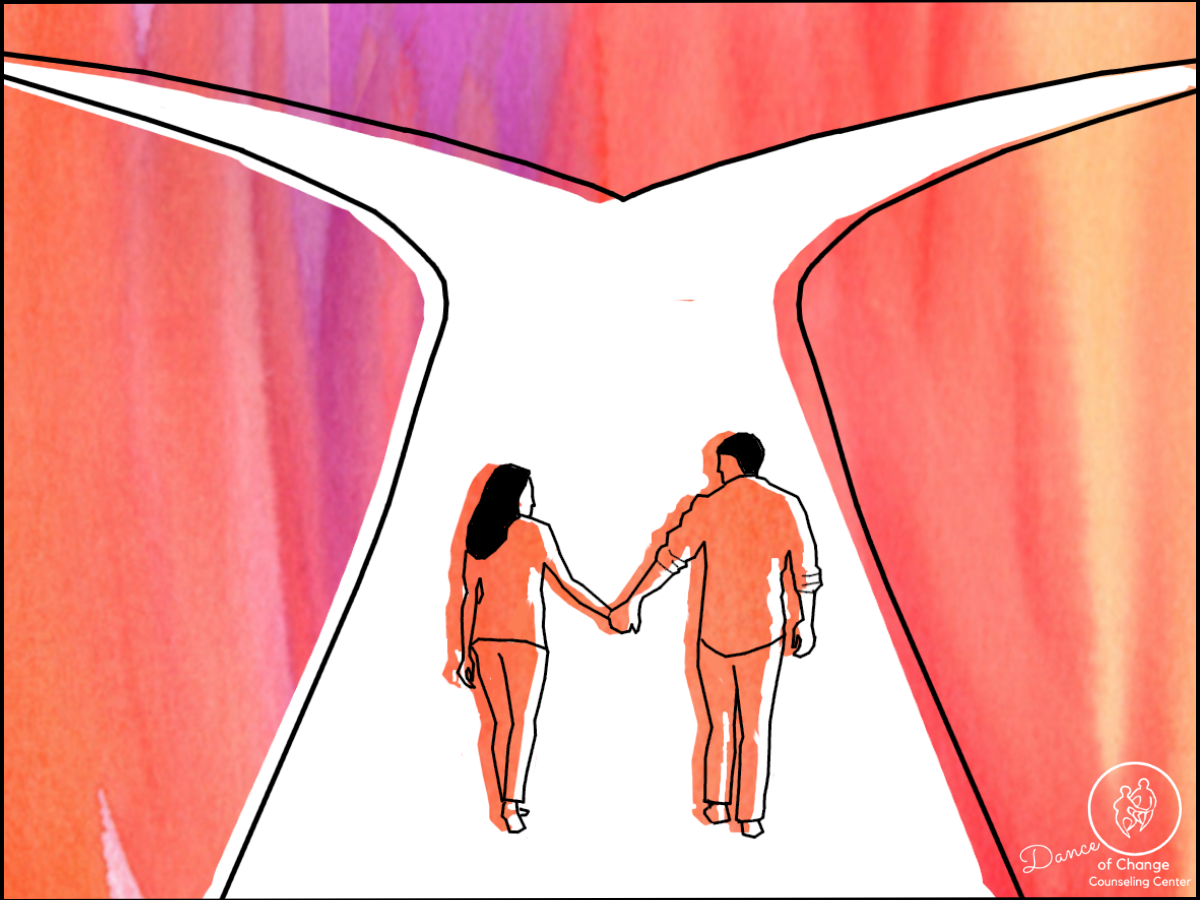
Ruby sits with her hands folded like two birds that can’t decide whether to fly or sleep. Jasper leans forward, elbows on knees, the posture of someone who has been ready to go for a long time but cannot see where the road begins. The room holds a practiced quiet, soft lamplight on the bookshelf, the faint hum of the vent, the clean rectangle of tissues stationed between them like a white flag that no one has raised yet.
“We’ve made some progress,” Ruby says, eyes fixed on the pattern of the rug. “A little bit.”
Jasper nods. “A little bit,” he echoes, as if the words might grow if repeated gently.
Progress is often a sound more than a sight, a change in the way breath moves through the body, a re-calibration of volume. On days like this, I can hear it. Hope, not triumphant exactly, but upright. Still, the air around us carries the ache of a sixteen-year argument that keeps changing masks. They have built a life together, two sons, two demanding careers, a history of holding each other up while looking past each other. All of that is true. And true, too, is the stalemate: the sense that something must change or else.
When a Marriage Can’t Continue, But Also Can’t End
There is a particular moment most couples arrive at, though they rarely name it this way.
It is not the moment they begin to struggle. That comes much earlier, often quietly, disguised as fatigue or misunderstanding or the slow accumulation of small disappointments that no one quite knows how to hold. And it is not the moment they decide to leave. That moment, when it comes, tends to be clearer, more final, even if it is painful.
This moment sits in between.
It is the moment when two people realize they cannot continue as they have been, but do not yet know if they can become something else.
In my work, this is where the air changes.
Couples begin to listen, not because they have suddenly become generous, but because they are running out of ways not to. The old strategies, the ones that once protected them, begin to reveal their cost. Urgency, withdrawal, control, silence, each has served a purpose. Each has kept something intact. But over time, they begin to erode the very thing they were meant to preserve.
And so the work shifts.
Not toward resolution, not yet, but toward the fragile, deliberate act of trying something different in the presence of uncertainty.
The Moment a Couple Begins to See and Hear Differently
“I was thinking about protected time,” Jasper says. “If we don’t set it, it doesn’t happen. And when it does happen, it turns into an argument, or… it’s not the right mode.”
He says “mode” like a technician diagnosing a machine.
Ruby exhales, slow. “If we agree the time is coming, I can meet it,” she says. “But I need to know you won’t ambush me. If it comes at me with urgency, I shut down.”
She pauses.
“I want a rule that we each take five minutes to ground before we start. Just five. So my body knows it’s safe.”
Autoimmune illness can do that, turn the whole world into a dimmer switch you keep reaching to steady. And when the body tells the truth in a new language, marriage must learn to translate or fall silent.
Jasper nods. “Good. Structure. I like that.”
Then, after a beat:
“But if we walk away… how is that not avoidance? We never finish what we start.”
Ruby turns to him.
“When you come in hot, it’s not a storm,” she says. “It’s a flood.”
Her eyes hold his.
“I need to know we can stop,” she says, “and that we will come back.”
How Embodied Listening Can Change A Relationship
Listening is not just done with the ears. And it’s not passive. When it’s done well, it’s an active, whole body experience.
It is a way of signaling safety.
When one partner feels heard, something shifts in the body, breath deepens, shoulders drop, the urgency to defend softens. The conversation becomes possible again, not because the problem is solved, but because the relationship system is no longer bracing for impact.
This is where many couples misunderstand the work.
They believe listening is about repeating works back like a parrot. Or it’s about being kind.
But more often, it is about being effective.
“You’ve both said something important,” I tell them. “That when listening happens, even imperfectly, it changes what your body does in the conversation.”
They nod, not quite in sync.
“If you get better at embodied listening,” I continue, “it reduces the stress response in the other person. Which means… it helps you.”
What Keeps Couples Stuck in the Same Cycle
Every agreement carries its own risk. Jasper names his first.
“If we pause… and never come back… then nothing gets resolved. It just becomes a cycle.”
Ruby nods.“And if you come at me with intensity and pressure,” she says, “I feel dread. Like I need to get away.”
For some couples, the threat is explosion. For others, it is disappearance.
Neither is right or wrong.
But together, they create a pattern neither can escape alone. They become a kind of stuck dance.
“Then we plan for that,” I say. “Not for when things are going well, but for when they aren’t.”
Jasper suggests a timestamp. A clear return. Ruby suggests naming the internal state before beginning.
“I need you to say you feel strongly,” she says. “So I know what’s happening.”
These are not solutions. They are attempts to interrupt the pattern.
Designing a Marriage Instead of Reacting to One
After they practice embodied listening together and managed to stay both regulated and attuned to each other there is a notable lightness in the room. Something feels different. And they instinctively reflect on it. “I’ve heard what’s been said,” Jasper says later. “And… something feels clearer.”
Ruby considers her answer more slowly.
“I didn’t get as activated as normally would,” she says. “And I could come back.”
Come back.
It is a small phrase, but it carries the weight of something much larger.
Couples often believe change comes from understanding. Or they believe it comes from insight or emotional catharsis.
But more often, it comes from these simple moments. Repeat them enough times and you have a whole new pattern. A whole new dance.
The new relationship pattern emerges and is practiced again and again, until the couple begins to trust it.
This is what it means to design a marriage.
Not to perfect it. And it’s not the simple easy solution we all long for (if only!)
But it’s designed and shape deliberately. Especially, in the places where it has historically broken down.
When a Couple Chooses to Stay Open Despite Everything
“So… I guess we try this at home,” Jasper says, hopefully. He appears both tired and resolute. Ruby nods, though her expression remains measured. “I don’t think it’s that easy,” she says.
“No,” I agree. In marriage, there are no promised outcomes or guarantees. Only the recognition that they have not yet exhausted what is possible between them. And there may still be something here worth fighting for.
“There are still things we might not agree on,” Jasper says.
“Maybe,” Ruby responds. “But we haven’t tried this yet.” It is not hope. Not quite, yet. But it is something close. And it is different for both of them.
When they stand to leave, something subtle has shifted. Jasper reaches for the door, then pauses, allowing Ruby to step through first. She doesn’t rush. There is space between them now. Not distance. Space.
After the door closes, the room returns to stillness. The chairs remain angled toward each other. The tissue box untouched. The air holding the faint imprint of something that has not resolved but has, perhaps, begun to move. This is where the work lives. Not in certainty. Not in resolution.
But in the quiet, deliberate effort of two people deciding, again, to choose each other. And to do so without threats, and despite uncertainty. But to remain in the process of discovery and courage.
People Also Search For
- When is it too late to save a marriage?
- Can couples therapy help when you feel stuck?
- Why do couples have the same arguments over and over?
- How do you communicate when your partner shuts down?
- What does emotional safety look like in a relationship?
- Can a marriage survive long-term resentment?
- How do you rebuild trust in a relationship?
- What happens in couples therapy sessions?
- Why does my partner feel like a threat during conflict?
- How do you stop the pursue-withdraw cycle?